One of the most overlooked barriers Indian students face isn’t lack of ambition. It’s lack of clarity. What career options exist? What roles align with their strengths? What skills do they need? In colleges across India, these questions echo loudly — especially for students from low-resource backgrounds or first-generation learners.
This is where structured career guidance begins to matter.
My Career Advisor, an AI-powered career guidance platform developed with the Ministry of Education and NCERT–PSSCIVE, crossed a meaningful milestone. While the number draws attention, the deeper story lies in how students are using the platform to understand career pathways more intentionally than before. By mapping interests and aptitudes to numerous career roles, the platform offers learners a clearer view of how academic choices connect to employability outcomes.
Unlike generic career advice, My Career Advisor offers personalized insights drawn from industry trends, helping learners identify what skills and experiences lead to each of them. For students who previously relied on hearsay or informal networks for career decisions, this context adds a layer of direction they haven’t had before.
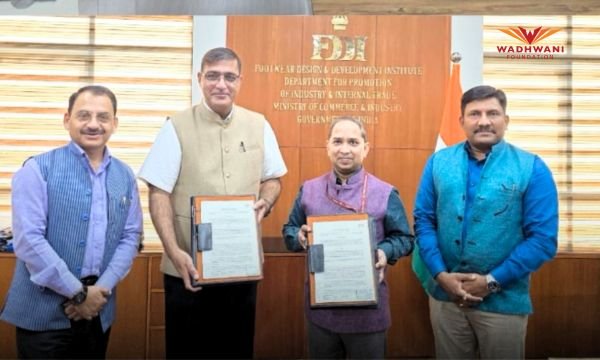
Institutional integration has been a key factor in this adoption. A national collaboration with the Footwear Design and Development Institute (FDDI) extended access to AI-powered career guidance across the FDDI campuses. The partnership was formalized between Shri Vivek Sharma, IRS, Managing Director, FDDI, and Shri Sunil Dahiya, Executive Vice President, Wadhwani Foundation, reinforcing a shared focus on strengthening job readiness through technology-enabled skilling.
Also Read: Skilling India for Success: Wadhwani Foundation Bridging Gap Between Dreams and Jobs
This kind of reframing matters because the first step toward employment isn’t just proficiency in tasks — it’s understanding where one’s strengths fit in the broader economy.
Another important development in 2025 was the Foundation’s recognition by NCVET as a Dual Awarding Body, enabling NSQF-aligned certification with stronger quality assurance. What this means for students is that skilling pathways they follow now carry formal recognition, helping bridge the gap between training and meaningful employability.
Broadening that impact, partnerships with state institutions are taking this guidance beyond isolated campuses into larger learning ecosystems. In Uttarakhand, for example, a collaboration with the state government and SETU Aayog earlier brought AI-powered soft skills and employability training to several students. Here, the focus is on foundational skills — communication, digital fluency, workplace preparedness — that enhance how learners present themselves in interviews, internships and entry-level roles.
These initiatives are not standalone experiments. They underline a shift in how career readiness is being approached within Indian higher education. Instead of treating career guidance as a final-year urgency or an optional add-on, institutions are starting to embed it earlier and more systematically into students’ learning journeys. The result is subtle, but emerging patterns point toward stronger alignment between student aspirations, market needs and skilling outcomes.
Learners engaging with an AI-based tool is a snapshot of growing traction, not an endpoint. It demonstrates early adoption by students who want clarity and actionable guidance, not surface-level information. The adoption is a signal that students recognize the value of structured guidance when planning for careers in an increasingly complex job market.
As more campuses integrate tools like My Career Advisor and as state-level skilling efforts expand, the narrative of employability in India is evolving: from reactive job hunting to proactive career preparation. When students understand their strengths, explore aligned career options, and build appropriate skills early on, the pathway to meaningful work becomes clearer — and, increasingly, more equitable.
The year 2025 showed that career clarity can scale beyond elite institutions and reach students across regions and contexts. What starts with understanding leads to preparation; what begins with engagement leads to opportunity. For India’s emerging workforce, that shift — from uncertainty to clear direction — may be one of the most important foundations of future success.
In this evolving skilling landscape, the role of ecosystem builders becomes quietly significant. By working alongside national institutions, state governments, and academic bodies, Wadhwani Foundation is helping bring structure, credibility, and scale to career guidance at a time when students need it most. Not as a standalone intervention, but as part of a larger effort to make career decision-making more informed, accessible, and aligned with real opportunities.