India’s growing youth population holds immense potential, but harnessing this demographic dividend requires the right skills. Through focused efforts in skilling, apprenticeships, entrepreneurship, global workforce readiness, and promotion of traditional trades, the government is empowering its citizens to become drivers of economic and social progress. Since 2014, the Ministry of Skill Development and Entrepreneurship has empowered more than 6 crore Indians through its various schemes to build a brighter future for themselves and for the country. PMKVY 5.0
At the heart of this transformation is India’s Skill India Mission (SIM), which is equipping youth with essential industry-relevant skills through various programs. These initiatives focus on skill development, re-skilling and up-skilling, empowering millions with the tools needed for sustainable careers. By bridging the skill gap, fostering innovation, and creating new job opportunities, SIM is paving the way for a self-reliant and developed India (Atmanirbhar and Viksit Bharat).
The flagship schemes under Skill India Mission (SIM) is Pradhan Mantri Kaushal Vikas Yojana (PMKVY).
Pradhan Mantri Kaushal Vikas Yojana (PMKVY): Empowering India’s Skilled Workforce
Summary: PMKVY is the flagship skill-certification scheme of the Government of India aimed at imparting market-relevant training to youth, boosting employability, and aligning India’s workforce with industry needs. Since its launch in 2015, PMKVY has evolved through multiple phases — adapting to changing economic demands and technological advancements.
Quick Facts
- Launch / Start Date: July 2015
- Implementing Agency: Ministry of Skill Development & Entrepreneurship (MSDE), through National Skill Development Corporation (NSDC) and designated Training Partners.
- Scheme Scope: Short-term training, recognition of prior learning (RPL), and special projects across a wide range of job roles aligned with the National Skills Qualification Framework (NSQF)
- Target Beneficiaries: Youth (school/college dropouts, unemployed), existing workers with informal skills, marginalized groups, migrants — broadly Indian nationals eligible under specific job-role criteria.
- Courses/Job-roles Approved (PMKVY 4.0): 813 NSQF-aligned job roles (676 active as of March 2024)
- Recent Scheme Data (as on 31 March 2024): Under PMKVY 4.0 — 23,61,798 enrolled, 5,43,636 trained, 2,55,902 certified.
About PMKVY
PMKVY is a centrally sponsored / centrally funded scheme launched by the Government of India to provide free (or government-sponsored) skill development training and certification aligned with industry requirements. By offering certified training, PMKVY aims to improve employability, facilitate livelihoods, and standardize skills across sectors — thereby bridging the skill gap in India’s workforce.
Under PMKVY, eligible individuals undergo training (or get their existing skills assessed), after which they receive certification under NSQF-aligned job roles. Certification helps them seek employment or entrepreneurship opportunities.
Purpose & Objective
The main objectives of PMKVY are:
- Provide industry-aligned, standardized vocational training to youth — especially school/college dropouts and unemployed youth — to improve their employability and livelihood prospects.
- Recognize and certify prior learning/ informal skills of existing workers (through RPL), thereby formalizing skills and improving opportunities for informal sector workers.
- Promote inclusion by reaching marginalized groups, migrants, women, and other disadvantaged populations, via special projects.
- Align skill training with evolving market and industry demands — including new sectors like digital technologies, manufacturing, services — to ensure workforce readiness for present and future jobs.
- Provide placement assistance, support entrepreneurship, and integrate with other national livelihood / development schemes for comprehensive socio-economic upliftment.
Also Read: Skilling for AI Readiness (SOAR) Initiative Launched to Make School Children AI Ready
| Version | Period | Key focus |
|---|---|---|
| PMKVY 1.0 | 2015–2016 (Pilot) | Launch of scheme; mobilizing youth, raising awareness about vocational training, initial short-term training and certification |
| PMKVY 2.0 | 15 July 2016 – March 2020 | Scaling up: larger coverage, expansion of sectors and geographies, addition of Recognition of Prior Learning (RPL) & Special Projects, alignment with national missions like Make in India, Digital India, Swachh Bharat. |
| PMKVY 3.0 | 2020–21 (pilot) → framework planned for 2021–2026 | Reorientation to changing needs; demand-driven, industry-linked and local-level (district-level) planning; focus on flexibility post-COVID; groundwork for longer-term 2021–26 phase. |
| PMKVY 4.0 | FY 2022–26 (ongoing) | Emphasis on emerging & “new-age” skills (Industry 4.0): AI, data analytics, robotics, IoT, advanced manufacturing & relevant job-roles; realigning skill ecosystem to future demands; process simplification; inclusion of institutions and digital platforms (e.g. Skill India Digital Hub). |
| PMKVY 5.0 | 2026 onwards | Not yet released |
Key Components of PMKVY:
The scheme comprises three main components:
- Short-Term Training (STT): For school/college dropouts or unemployed youth. Training is aligned with NSQF (levels ≤ 5), typically 150–300 hours, and includes soft skills, entrepreneurship, financial/digital literacy besides technical skill. Training and assessment fees are borne by the government. On completion, placement assistance is provided.
- Recognition of Prior Learning (RPL): For individuals who already possess informal or experiential skills. Their competencies are assessed and certified under appropriate job roles — helping formalize their skills and improve employability. Sometimes “bridge courses” are offered to fill knowledge gaps.
- Special Projects (SP): Custom training initiatives for specific target groups or special job roles — e.g., marginalized communities, persons with disabilities, remote/migrant workers, or roles not covered under standard Qualification Packs (QPs)/National Occupational Standards (NOS).
These components allow PMKVY to cater both to fresh trainees and existing informal-skilled workers, and tailor skilling to special needs or sectors.
Beneficiaries:
- Youth (school/college dropouts, unemployed): The core target — enabling them to acquire vocational/technical skills for employment or self-employment.
- Existing workers with informal skills: Through RPL, unrecognized informal labour can get certified under standard job-roles.
- Marginalized groups / special categories: Under Special Projects, scheme aims to reach those often excluded — e.g. migrants, persons with disabilities, disadvantaged communities.
- Employers / Industry: Indirect beneficiaries — availability of certified skilled workforce aligned with industry demands; helps bridge skill-gap for employers.
Eligibility broadly requires Indian nationality, and for RPL — prior experience/skills in the given job role (as per scheme guidelines) along with valid identity (e.g. Aadhaar). For many roles, compliance with NSQF and job-role-specific criteria is required.
Join us on WhatsApp, Click Here
Implementation & Governance
- The scheme is implemented by MSDE through NSDC and its network of Training Partners (TPs), Project Implementing Agencies (PIAs), and Sector Skill Councils (SSCs) as applicable.
- Training Centres (TCs) deliver STT; PIAs/SSC-backed agencies implement RPL; Special Projects may be run by government bodies, corporates, or other stakeholders depending on the project.
- The Government pays for training and assessment fees; Training Partners are paid as per “Common Norms.”
- For PMKVY 4.0, the scheme has moved toward a more integrated and flexible model: use of digital platforms (e.g. Skill India Digital Hub) to streamline enrolment, tracking training life-cycle, and ensure efficient delivery.
Certification & Assessment
- All training courses under PMKVY are aligned to NSQF levels (for STT) to ensure standardization.
- After training (or RPL) the candidate is assessed by authorized assessors. Upon successful assessment, the candidate is certified. Certification increases job-readiness and recognition across industries.
- For RPL, where prior learning is recognized, “bridge courses” may be offered to fill any identified knowledge or competency gaps before final assessment.
Impact & Results
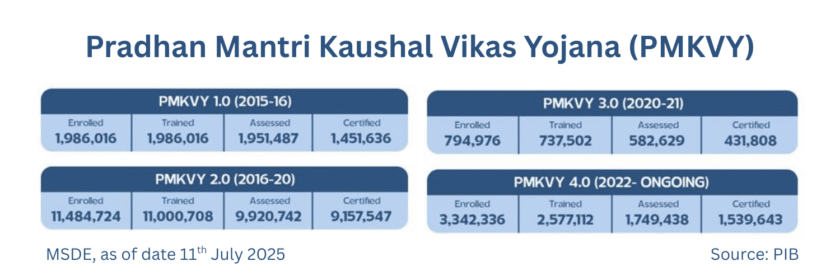
- According to one public summary, over 1.63 crore (16.3 million) candidates have been trained under PMKVY across different phases.
- Under PMKVY 4.0 (as on 31 March 2024): 23.62 lakh enrolled; 5.43 lakh trained; 2.56 lakh certified.
- Under earlier phases: during PMKVY 1.0 alone ~19.85 lakh trained.
- According to a parliamentary/ministerial update: among “first three phases,” out of 71 lakh trained individuals, 43% (≈ 24.37 lakh) secured placements.
- PMKVY’s broad sectoral span (manufacturing, services, construction, electronics, IT, retail, etc.) — helps meet diverse employment market demands.
Note on data limitations: While scheme reports provide enrolment/training/certification numbers, official data on long-term placement rates, job retention, or earnings increments after certification is not consistently available in public documents. Where placement numbers are cited, they refer to placement assistance or placement claims by Training Partners, which may not track long-term outcomes.
Monitoring, Quality Assurance & Challenges
- PMKVY uses standardised guidelines (for STT, RPL, SP) to ensure training quality, aligned to NSQF and qualification packs.
- Training and assessment fees are government-funded, reducing financial barriers for candidates.
- For PMKVY 4.0, digital tools (e.g. Skill India Digital Hub) aim to improve transparency, tracking and reduce administrative delays or quality lapses.
- Challenges: As with many large-scale skill-development schemes — ensuring consistent training quality across diverse Training Partners; verifying that placement support leads to sustainable employment; matching training/vocational outcomes with rapidly evolving industry demands; ensuring inclusion of marginalized groups; avoiding misuse of resources. Publicly available sources note that placement rates remain a concern (e.g. in earlier phases only ~43 % placement reported for a subset).
Current Status
- The latest phase, PMKVY 4.0 (FY 2022–26), is underway. The scheme has updated course offerings to include emerging “Industry 4.0” skills — e.g. AI, data analytics, robotics, IoT — to meet evolving labour market needs.
- Under PMKVY 4.0, as of 31 March 2024: 813 NSQF-aligned job roles approved, 676 active for training.
- The scheme aims to harness digital platforms via Skill India Digital Hub to streamline enrolment, training, assessment, certification, and possibly tracking post-certification outcomes.
- Government continues to encourage convergence of PMKVY with other national initiatives (education, employment, livelihood, inclusive growth) to maximize its social and economic impact.
Policy Recommendations & Outlook
Based on publicly available data and scheme design, some evidence-backed suggestions for strengthening PMKVY’s impact could be
- Better tracking of post-certification outcomes: Collect and publish data on long-term employment, job retention, earnings increment, to assess real impact beyond placement assistance.
- Strengthen quality assurance mechanisms: Uniform audits of Training Partners / assessors — especially with scaling of job-roles and inclusion of emerging/advanced courses — to maintain training standards.
- Focus on demand-driven skilling tied to regional/industry labour market mapping: Especially under PMKVY 4.0 — ensure that skill offerings match actual employer demand; avoid mismatch between certifications and jobs.
- Enhance inclusivity & outreach — especially for rural, marginalized, migrant, informal-sector populations: Through Special Projects, RPL, and collaboration with State Skill Missions / local bodies.
- Integration with other socio-economic and education policies: E.g. link PMKVY skill certifications with formal education pathways (via credit transfers), micro-enterprise / entrepreneurship support, and social security — to ensure sustainable livelihoods.
Given rapid technological change and evolving labour-market demands, PMKVY remains a critical tool — but its success will depend on continuous adaptation, transparency, and robust follow-up.
PMKVY 5.0 – Speculative
Some social-media posts on leading platforms like LinkedIn and industry-forum messages talk about “PMKVY 5.0” as an upcoming or proposed next phase. However — these are not official government announcements. The same sources explicitly state that “this is not an official update — expectations based on industry conversations & ecosystem feedback.”
Restructuring / consolidation activity was reported in 2025 (merging certain skilling schemes and aligning initiatives). There are summaries and government actions in 2024–25 showing restructuring and efforts to integrate PMKVY 4.0 with other schemes (mentions of consolidation or re-orientation appear in ministry summaries and secondary coverage). For example, a February 2025 restructuring/merger summary is reported in policy briefings which indicates evolution of the skill mission — but not a formal “PMKVY 5.0” launch.
The official portal/dashboard of the scheme does not mention “PMKVY 5.0.” As of last public update, “PMKVY 2.0 and 3.0 have been closed and no trainings are ongoing under them; budget announcement made for PMKVY 4.0.”
Hence, as of now, PMKVY 4.0 remains the official, active phase. References to “PMKVY 5.0” are speculative, informal, or based on stakeholder discussions — not on official government action.
Any genuine PMKVY-5.0 launch would appear as an MSDE/GOI notification, Cabinet note or Gazette notification and be posted on MSDE/NSDC/PIB and in parliamentary records. You can follow Skill Reporter for updates on PMKVY 5.0
References:
- PMKVY
- Guidelines for Pradhan Mantri Kaushal Vikas Yojana 3.0
- Guidelines for PMKVY 4.0
- Progress made under PMKVY (contains PMKVY 4.0)
- Ministry of Skill Development & Entrepreneurship. Annual / Scheme Report 2023–24 (contains PMKVY 4.0 data)
- PMKVY Dashboard
- 10 years of Pradhan Mantri Kaushal Vikas Yojana