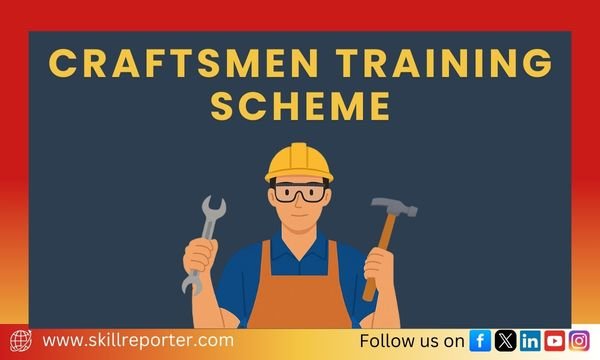
The Craftsmen Training Scheme (CTS) is the oldest and largest vocational training program in India. Launched in 1950 by the Directorate General of Training (DGT) under the Ministry of Skill Development & Entrepreneurship (MSDE), the scheme is implemented through a nationwide network of Industrial Training Institutes (ITIs).
The core objective is to:
- Provide industry-relevant skills to youth
- Ensure a steady flow of skilled workers for industries
- Reduce unemployment and promote self-employment
- Enhance the productivity and quality of India’s workforce
Trainees who successfully complete CTS courses are awarded a National Trade Certificate (NTC) after passing the All India Trade Test (AITT), which is recognized nationally and internationally.
Implementation
CTS operates at multiple levels for effective reach:
- National Level: DGT designs curriculum, maintains quality standards, and conducts assessments through NCVT.
- State Level: State Directorates of Training manage admissions, monitoring, and ITI administration.
- District/Block Level: Training is imparted at local Government and Private ITIs, ensuring accessibility in semi-urban and rural areas.
This decentralized model with central oversight ensures that skilling reaches the grassroots while maintaining uniform standards.
Eligibility
| For Regular Trainees | For Private Candidates (Direct AITT Applicants) | |
| Age | Minimum 14 years (no upper limit) | Minimum 21 years |
| Education | From Class VIII pass to Class XII pass, depending on the trade | At least 3 years of work experience in the relevant trade/sector |
Beneficiaries
- Youth: School leavers seeking employable skills
- Industry: Receives job-ready manpower
- Private Candidates: Informal sector workers looking for certification
- Entrepreneurs: Trained individuals starting self-employment or micro-businesses
Trades and Courses Offered
CTS covers a wide spectrum of trades under two categories:
- Engineering Trades (e.g., Electrician, Fitter, Mechanic, Welder, Turner, Refrigeration & Air Conditioning)
- Non-Engineering Trades (e.g., Stenography, Sewing Technology, Computer Operator, Health Sanitary Inspector, Fashion Design & Technology)
Course Duration and Details:
- Varies from 6 months to 2 years depending on trade
- Follows a modular and competency-based curriculum
- Includes 70% practical and 30% theory
Where CTS Stands Today
- India has over 15,000 ITIs (Govt. + Pvt.) affiliated under DGT, offering training under CTS.
- More than 130+ trades are available across states.
- CTS admissions continue annually, with the August 2025 admission cycle already underway.
- CTS forms a backbone of Skill India Mission, complemented by schemes like PMKVY (short-term training) and NAPS (apprenticeship).
Regulatory Framework
- Directorate General of Training (DGT), MSDE: Policy, standards, and oversight
- National Council for Vocational Training (NCVT): Conducts examinations and awards NTC
- State Councils for Vocational Training (SCVTs): Operate in parallel for state-level coordination
Linkages and Integration
CTS is not standalone—it connects with other skilling and employment pathways:
- National Apprenticeship Promotion Scheme (NAPS): CTS graduates are prime candidates for apprenticeships.
- Industry Collaborations: CTS trades are periodically updated to align with industry 4.0 needs (e.g., Robotics, IoT, AI-enabled manufacturing).
- Higher Education Pathways: NTC holders can pursue Diplomas, B.Voc, or lateral entry into polytechnics/engineering programs.
- PM Vishwakarma Scheme: Complementary for traditional artisans to formalize and upgrade skills.
Key Takeaways
- Oldest skill training scheme in India (since 1950).
- Implemented at all levels—from national policy to block-level ITIs.
- Open eligibility (14+ for youth, 21+ for private candidates).
- Beneficiaries: School dropouts, informal workers, industries, entrepreneurs.
- Current footprint: 15,000+ ITIs, 130+ trades, lakhs of students trained annually.
- Regulated by DGT (MSDE) with certification via NCVT.
- Backbone of Skill India—linking with NAPS, PMKVY, and higher education pathways.
The information presented in this article is compiled from publicly available government and secondary sources. While care has been taken to ensure accuracy, the author/publisher is not responsible for the authenticity, completeness, or current validity of the content. Readers should verify details from official notifications before making decisions based on this information.