For many Indian students, entrepreneurship often enters the conversation late — after graduation, after a job stint, or once an idea accidentally takes shape. What’s usually missing early on is exposure to the fundamentals: how businesses actually work, how ideas are tested, and how real-world constraints shape outcomes.
Across campuses in India, that gap is beginning to narrow.
Through the Wadhwani IGNITE program, entrepreneurship is being introduced not as an outcome, but as a skillset — one that students can systematically acquire, even before they have a business idea. The approach is intentional: building mindset through skilling first, strengthening fundamentals next, and moving to execution only thereafter.
Entrepreneurship is not as an Outcome, but as a Skillset
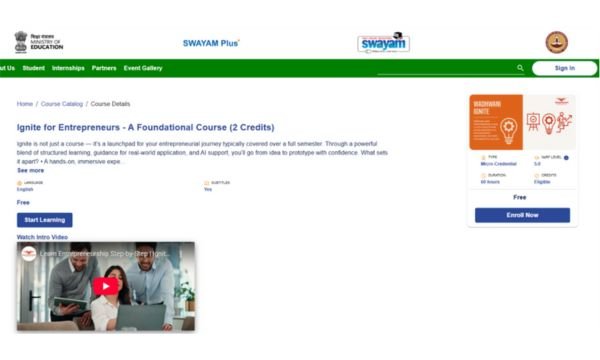
A major step in this direction came with IGNITE going live on SWAYAM Plus, making structured entrepreneurship education accessible to students nationwide. Aligned with the National Credit Framework (NCrF), the course blends globally recognized startup frameworks with Indian market realities. For students encountering entrepreneurship for the first time, this creates a clear and credible starting point.
What sets IGNITE apart is its emphasis on learning before launching. Participants are introduced to concepts like problem identification, customer discovery, value propositions, and basic financial thinking — without the pressure to immediately “build a startup.” This approach lowers the entry barrier, especially for learners who may not come from entrepreneurial backgrounds.
This foundation-first model is being reinforced through partnerships with Indian universities. Collaborations with institutions such as Central University of Haryana have led to the launch of undergraduate and postgraduate entrepreneurship programs under IGNITE. These programs embed entrepreneurship into formal curricula, ensuring that exposure is consistent, assessed, and academically recognized.
Similarly, IGNITE’s rollout across technical and state universities — including I.K. Gujral Punjab Technical University (IKGPTU) — reflects growing institutional acceptance that entrepreneurial skills and an enterprising mindset are core graduate capabilities, not niche interests. Faculty development initiatives linked to these programs are strengthening teaching capacity, allowing educators to guide students through entrepreneurial concepts with greater confidence and structure.
Beyond classrooms, IGNITE has also been delivered through bootcamps and hackathon-style formats trusted by leading institutions such as IITs, NITs, and large private universities. These formats introduce students to hands-on learning focused on core entrepreneurial capabilities — idea validation, team formation, and pitch thinking — while remaining firmly grounded in fundamentals rather than outcomes.
Also Read: Building Job-Ready Futures: Wadhwani Foundation’s Ongoing Efforts in Shaping India’s Workforce
The intent is clear: entrepreneurship education should not depend on whether someone already has an idea. It should equip them with the ability to develop one responsibly when the time comes.
What emerges from this ecosystem is not a rush toward startup creation, but a gradual build-up of entrepreneurial literacy. Students begin to understand risk, effort, and iteration. They learn that failure is part of the process, not a personal shortcoming.
Most importantly, they gain the confidence to engage with entrepreneurship as a viable path — whether immediately or later in life.
Quietly, this approach is reshaping how entrepreneurship is perceived on Indian campuses. It moves the conversation away from glamorized success stories and toward capability-building at scale.
Through IGNITE, Wadhwani Foundation is helping anchor entrepreneurship education where it arguably matters most — at the beginning of the journey. By focusing on fundamentals, accessibility, and institutional integration, the program is contributing to a generation of students who are better prepared to build, experiment, and create value responsibly when opportunity presents itself.
Not every student will become an entrepreneur.
But every student can learn how entrepreneurs think.
And that shift, over time, has the potential to strengthen India’s innovation and job-creation pipeline from the ground up.