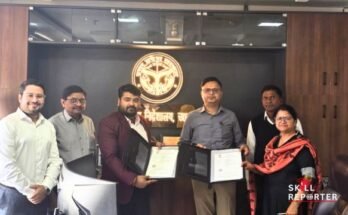
Nigeria’s Federal Ministry of Education has formalized a partnership with Singapore’s Institute of Technical Education Services (ITEES). The agreement, signed recently, aims to strengthen Nigeria’s technical and vocational education and training (TVET) system. The signing ceremony was held via videoconference linking Abuja and Singapore, with the National Board for Technical Education (NBTE) representing the Nigerian side and ITEES representing Singapore.
The collaboration dates back to a 2025 visit by Nigerian Education Minister Maruf Tunji Alausa to Singapore, where he met his counterpart Desmond Lee and toured ITE campuses. Subsequent discussions with Singapore’s High Commissioner to Nigeria, Lim Sim Seng, led to the finalization of the agreement.
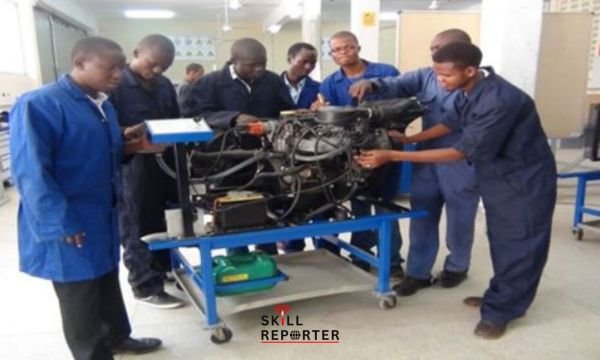
Under the agreement, ITEES will implement a train-the-trainer program designed, according to the official communiqué, to “strengthen the pedagogical skills and assessment capabilities of TVET teachers across Nigeria.” Leadership training will also be offered in Singapore for school principals and department heads. The Global Excellence Model for Skills Training (GEMSET) will also be used to benchmark Nigerian institutions against internationally recognized standards.
Subscribe to our WhatsApp Channel, Click Here
The government has been explicit about its objectives. The ministry stated that the initiative “is part of efforts to reposition technical education as a driver of economic growth, job creation and industrial development.” The choice of Singapore as a partner is deliberate. According to Xiaoyan Liang, an education specialist at the World Bank, TVET graduate employment rates exceed 80% in countries such as Germany, China and Singapore, placing the city-state among the world’s leading models for skills-based labor market integration.
The partnership comes amid mounting pressure on Nigeria’s labor market. According to the Q2 2024 labor force report from the National Bureau of Statistics, informal employment remains pervasive, accounting for 93% of all jobs in the country. In response, the federal government has launched a TVET curriculum reform covering 25 priority sectors, including automotive technology, welding, solar installation and hospitality, with free tuition and a monthly stipend for unemployed youth. The partnership with ITEES is intended to inject internationally recognized expertise into that broader reform effort.