
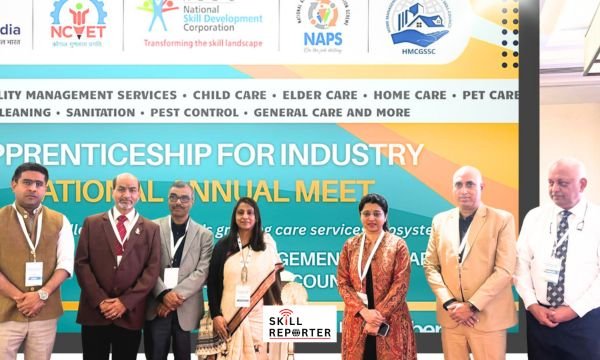
The Home Management & Care Givers Sector Skill Council (HMCG SSC) successfully organized its National Annual Meet – “Apprenticeship for Industry 2025” at the India Habitat Centre, New Delhi, bringing together senior policymakers, industry leaders, employers, training partners, and experts from the skill development ecosystem. Over 50 delegates from all over India graced the Meet.
The national-level meet focused on strengthening apprenticeship-led workforce development under the National Apprenticeship Promotion Scheme (NAPS), with a special emphasis on the rapidly expanding home management and care services sector. The deliberations addressed the widening “care gap” and the urgent need to formalize a sector that holds the potential to contribute up to 17% of India’s GDP.
Reimagining the Care Economy
In her inaugural address, Prof. Mona Gupta, CEO, HMCG SSC, highlighted the sector’s historic transition from the informal label of “Domestic Workers” to a structured and professional Home Management and Caregiving (HMCG) ecosystem. As unpaid and informal care work continues to impact women’s time and ability to join the workforce. She emphasized that over 30 specialized job roles—ranging from homecare, housekeeping for home and establishments to estate management and lifelong home care for preborn to elderly—have now been formally recognized.
She further shared that HMCG SSC is actively mainstreaming vocational education by collaborating with NCERT, universities, and academic institutions, with the objective of positioning caregiving and home management as a “first-choice” career pathway for Indian youth. Prof. Gupta noted that the sector’s growth can only be sustained by dignifying the workforce through certification, career progression, and competitive benefits.
Keynote Address: Apprenticeships as the Backbone of Care Services
Delivering the keynote address, Mr. G.C. Rama Murthy, Regional Director, RDSDE–Karnataka, highlighted a critical demand–supply gap in the sector with respect to NAPS. While major employers including Sodexo and Urban Care together have an estimated 1.94 lakh job openings, the number of apprentices currently engaged stands at only 1,042.
Mr. Murthy underscored that care work (formerly known as domestic work) is one of the few sectors that cannot be replaced by Artificial Intelligence, as it relies heavily on human empathy, trust, and presence. He emphasized that the burden of care work continues to fall disproportionately on families—especially women, making structured apprenticeships essential to building a trained and equitable workforce.
He also pointed out that despite technological advancements, the human element in caregiving remains non-negotiable, particularly as the home care market is projected to reach USD 64.4 billion by 2033.
Transforming Apprentices from “Li-ability” to “Ability”
A high-level panel discussion with TPAs and Policy Makers focused on empowering apprenticeships and improving workforce quality through NAPS:
- Mr. G.C. Rama Murthy advocated for a nationwide, standardized syllabus to ensure apprentices are trained to consistent, industry-ready standards.
- Mr. Sushil Kumar Aggarwal, Regional Director (Haryana & Chandigarh), urged employers to view apprentices as “Li-ability”—assets with leadership potential—and recommended integrating IoT and modern assistive technologies and design thinking into the training programs which will impact the desired motivation to students to seek NAPS.
- Mr. Shashank Gupta (Distil Education) and Mr. Nikhil Kumar (Spectrum Talent Management) together emphasized that NAPS creates mutual value both for the employer by adding to bottom lines and for the students by making him ready for permanent employment—offering structured career entry for youth aged 14–35 years while addressing skilled manpower needs in a developing economy.
Industry Perspectives: Safety, Dignity, and Workforce Sustainability
An engaging Fireside Chat brought forward practical industry experiences and success stories from the leaders of the sector:
Dr. Srinivas Rao Pulijala, CEO, Apollo MedSkills, shared that Apollo regulatory alone employs over 2,000 apprentices, and noted that official recognition from bodies will enhance industry confidence in apprenticeship-trained talent. He also highlighted that hospitals, home care providers, and other care agencies have a continuous and accelerating demand for housekeeping and care staff, particularly in a sector facing 38% attrition.
Professionalizing the Workforce: Mr. Binay P. Singh (Indian Pest Control Association) and Ms. Bani Jain (ASLI) stressed the need to “glamorize” (signifies trust and dignity) caregiving roles through defined career pathways, skill recognition, and international mobility opportunities, helping break long-standing blue-collar perception. At a time when automation is shrinking employment avenues for this sector will be immense.
Closing Specialized Skill Gaps: Dr. Harish Chawla (Hope ek Asha) emphasized the growing need for specialized elderly care training for dementia, senior care at homes and in establishments. transforming informal domestic roles into professional home-care services.
The Way Forward
The meet concluded with a strong collective call for a comprehensive apprenticeship model that integrates on-the-job training, structured curriculum, formal mentorship, and industry ownership. Stakeholders reaffirmed their commitment to expanding apprenticeship adoption and strengthening collaboration between government, industry, and skilling institutions.
Thanking all participants, Prof. Mona Gupta remarked that the “circle is now complete”, with industry leaders, associations, and policymakers aligned on dignifying the sector workforce. She noted that with India projected to require 14.5 million care workers by 2025, which essentially includes all direct and indirect domestic works. Apprenticeships will be critical to building a formal sustainable, skilled, and respected sector with global career pathways and informed migration.