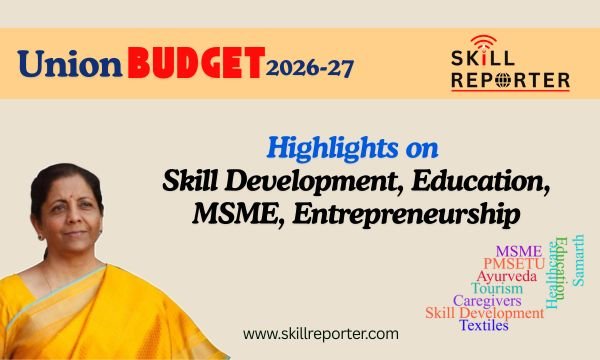
New Delhi: On the sacred occasion of Magha Purnima and the birth anniversary of Guru Ravidas, Union Minister for Finance and Corporate Affairs, Smt Nirmala Sitharaman presented the Union Budget 2026-2027 in Parliament today which is inspired by 3 kartavya:
- First kartavya is to accelerate and sustain economic growth, by enhancing productivity and competitiveness, and building resilience to volatile global dynamics. To accelerate and sustain economic growth, interventions were proposed in six areas:
- Rejuvenating legacy industrial sectors
- Scaling up manufacturing in 7 strategic and frontier sectors
- Developing City Economic Regions
- Ensuring long-term energy security and stability
- Delivering a powerful push to Infrastructure
- Creating “Champion MSMEs”
- Second kartavya is to fulfil aspirations of people and build their capacity, making them strong partners in India’s path to prosperity. Close to 25 crore individuals have come out of multidimensional poverty through a decade of Government’s sustained and reform-oriented efforts.
- Third kartavya, aligned with vision of Sabka Sath, Sabka Vikas, is to ensure that every family, community, region and sector has access to resources, amenities and opportunities for meaningful participation.
Presenting the Yuva Shakti-driven Budget which emphasizes on Government’s ‘Sankalp’ to focus on poor, underprivileged and the disadvantaged, the finance minister said, India will continue to take confident steps towards Viksit Bharat, balancing ambition with inclusion. As a growing economy with expanding trade and capital needs, India must also remain deeply integrated with global markets, exporting more and attracting stable long-term investment.
The budget 2026-27 has sharply scaled up spending on skill development, with the Ministry of Skill Development and Entrepreneurship receiving an allocation of Rs 9,885.80 crore. In her Budget speech, Union Finance Minister signalled a renewed push to link skilling with jobs, services-led growth, and India’s long-term demographic dividend.
Skill Development & Employment
Textile & Apparels:
For the labour-intensive Textile Sector, an Integrated Programme with 5 sub-parts was proposed:
- The National Fibre Scheme for self-reliance in natural fibres such as silk, wool and jute, man-made fibres, and new-age fibres;
- Textile Expansion and Employment Scheme to modernise traditional clusters with capital support for machinery, technology upgradation and common testing and certification centres;
- A National Handloom and Handicraft programme to integrate and strengthen existing schemes and ensure targeted support for weavers and artisans;
- Samarth 2.0 to modernize and upgrade the textile skilling ecosystem through collaboration with industry and academic institutions.
- Mahatma Gandhi Gram Swaraj initiative announced, to strengthen khadi, handloom and handicrafts.
Initiative to help in global market linkage, branding and will streamline and support training, skilling, quality of process and production. The budget specifies that it will streamline and support training, skilling, quality of process and production.
Waterways:
To promote environmentally sustainable movement of cargo, new Dedicated Freight Corridors connecting Dankuni in the East, to Surat in the West proposed and to operationalise 20 new National Waterways (NW) over next 5 years, starting with NW-5 in Odisha to connect mineral rich areas of Talcher and Angul and industrial centres like Kalinga Nagar to the Ports of Paradeep and Dhamra. Training Institutes will be set up as Regional Centres of Excellence for development of the required manpower.
Tourism & Hospitality:
- National Council for Hotel Management and Catering Technology to be upgraded to National Institute of Hospitality as a bridge between academia, industry and the Government.
- A pilot scheme for upskilling 10,000 guides in 20 tourist sites announced through a standardized, high-quality 12-week training course in hybrid mode In collaboration with an IIM.
- A National Destination Digital Knowledge Grid to be established to digitally document all places of significance—cultural, spiritual andheritage. This initiative will create a new ecosystem of jobs for local researchers, historians, content creators and technology partners.
Care Ecosystem:
Building a strong Care Ecosystem, covering geriatric and allied care services will be built. A variety of NSQF-aligned programmes will be developed to train multiskilled caregivers combining core care and allied skills, such as, wellness, yoga and operation of medical and assistive devices. In the coming year, 1.5 lakh caregivers will be trained.
Scheme for PwDs:
Divyangjan Kaushal Yojana – providing dignified livelihood opportunities through industry-relevant and customized training specific to disability groups. IT, AVGC sectors, Hospitality and Food and Beverages sectors offer task-oriented and process-driven roles, which are suitable for Divyangjans.
Semiconductors:
India Semiconductor Mission (ISM) 2.0 to be launched to produce equipment and materials, design full-stack Indian IP, and fortify supply chains; focus will be on industry led research and training centres to develop technology and skilled workforce.
Ayurveda:
The union budget 2026 proposed
- set up 3 new All India Institutes of Ayurveda;
- upgrade AYUSH pharmacies and Drug Testing Labs for higher standards of certification ecosystem, and make available more skilled personnel;
- upgrade the WHO Global Traditional Medicine Centre in Jamnagar to bolster evidence-based research, training and awareness for traditional medicine.
Sports
Taking forward the systematic nurturing of sports talent which is set in motion through the Khelo India programme, the launch of Khelo India Mission to transform the Sports sector over the next decade. The Mission will facilitate:
- An integrated talent development pathway, supported by training centres
- systematic development of coaches and support staff;
- integration of sports science and technology;
- competitions and leagues to promote sports culture and provide platforms; and,
- development of sports infrastructure for training and competition.
Sabka Sath, Sabka Vikas
- Focus on the Purvodaya States and the North-East Region to accelerate development and employment opportunities.
- Empowering Divyangjan through access to livelihood opportunities, training and high-quality assistive devices
Emerging Technologies including AI:
21st Century is technology driven. Adoption of technology is for the benefit of all people – farmers in the field, women in STEM, youth keen to upskill and Divyangjan to access newer opportunities. The Government has taken several steps to support new technologies through AI Mission, National Quantum Mission, Anusandhan National Research Fund, and Research, Development and Innovation Fund.
INR 139289 Crores Budget Estimates for Education in 2026-27
Education
Healthcare:
To promote India as a hub for medical tourism services, a Scheme proposed to support States in establishing five Regional Medical Hubs, in partnership with the private sector. These Hubs will serve as integrated healthcare complexes that combine medical, educational and research facilities. These Hubs will provide diverse job opportunities for health professionals including doctors and AHPs.
AVGC Sector
With the emerging technologies playing a pivotal role in India’s Orange Economy, the Budget underscores India’s Animation, Visual Effects, Gaming and Comics (AVGC) sector as a growing industry projected to require 2 million professionals by 2030. Support proposed to the Indian Institute of Creative Technologies, Mumbai in setting up AVGC Content Creator Labs in 15,000 secondary schools and 500 colleges in furtherance of India’s Orange economy.
STEM
In Higher Education STEM institutions, prolonged hours of study and laboratory work pose some challenges for girl students. Through VGF/capital support, 1 girls hostel will be established in every district.
Design:
The Indian design industry is expanding rapidly and yet there is a shortage of Indian designers. The Union Budget proposes to establish, through challenge route, a new National Institute of Design to boost design education and development in the eastern region of India.
University Townships:
The Government will support States, through challenge route, in creating 5 University Townships in the vicinity of major industrial and logistic corridors. These planned academic zones will host multiple universities, colleges, research institutions, skill centres and residential complexes.
Ease of Living:
- to reduce TCS rate for pursuing education and for medical purposes under the Liberalized Remittance Scheme (LRS) from 5 percent to 2 percent.
High-Powered ‘Education to Employment and Enterprise’ Standing Committee:
To set up a High-Powered ‘Education to Employment and Enterprise’ Standing Committee to recommend measures that focus on the Services Sector as a core driver of Viksit Bharat. This will make India a global leader in services, with a 10% global share by 2047. The Committee will prioritise areas to optimise the potential for growth, employment and exports. They will also assess the impact of emerging technologies, including AI, on jobs and skill requirements and propose measures thereof.
Indicative Terms of Reference of the High-Level Education-to-Employment and Enterprise Standing Committee
- identify services sub-sectors with potential for growth, employment and exports, identify sector-specific gaps and measures to unlock employment potential;
- identify cross-sectoral policy and regulatory issues, including standards-setting and accreditation;
- examine areas for services export;
- assess the impact of emerging technologies, including AI, on jobs and skill requirements;
- propose specific measures for embedding AI in the education curriculum from school level onwards and upgrading State Councils of Educational Research and Training institutes for teacher training;
- propose measures for upskilling and re-skilling of technology professionals/engineers in AI and emerging technologies; and
- propose measures for AI enabled matching of worders, jobs and training opportunities; and
- propose measures to make the informal workflow visible, verifiable and future-ready, to enhance upward mobility prospects; and
- propose steps to be taken to attract skilled diaspora and foreign talent into the country.
A dedicated ₹10,000 crore SME Growth Fund Introduced
Entrepreneurship & MSME
- Recognising MSMEs as a vital engine of growth, proposed a three-pronged approach to help them grow as Champions under the first Kartavya.
- First is the Equity support in which, she introduced a dedicated ₹10,000 crore SME Growth Fund, to create future Champions, incentivizing enterprises based on select criteria.
- It was also proposed to top up the Self-Reliant India Fund set up in 2021, with ₹2,000 crore to continue support to micro enterprises and maintain their access to risk capital.
- On the second approach of Liquidity support, with TReDS, more than ₹7 lakh crore has been made available to MSMEs. To leverage its full potential, 4 measures are proposed: (i) mandate TReDS as the transaction settlement platform for all purchases from MSMEs by CPSEs, serving as a benchmark for other corporates; (ii) introduce a credit guarantee support mechanism through CGTMSE for invoice discounting on TReDS platform; (iii) link GeM with TReDS for sharing information with financiers about government purchases from MSMEs, encouraging cheaper and quicker financing; (iv) introduce TReDS receivables as asset-backed securities, helping develop a secondary market, enhancing liquidity and settlement of transactions.
- Professional support, the Government to facilitate Professional Institutions such as ICAI, ICSI, ICMAI to design short-term, modular courses and practical tools to develop a cadre of ‘Corporate Mitras’, especially in Tier-II and Tier-III towns. These accredited para-professionals will help MSMEs meet compliance requirements at affordable costs.
SHG Entrepreneurship
Building on the success of the Lakhpati Didi Programme, Self-Help Entrepreneur (SHE) Marts will be set up as community-owned retail outlets within the cluster level federations through enhanced and innovative financing instruments.
Budget Outlay for Major Schemes
| Scheme | Budget Estimate (INR in Crores) |
|---|---|
| Samagra Shiksha | 42100 |
| PM SHRI | 7500 |
| PM USHA | 1850 |
| Prime Minister Formalization of Micro Food Processing Enterprises Scheme (PM FME) | 1700 |
| Human Resources for Health and Medical Education | 1725 |
| Pradhan Mantri Skilling and Employability Transformation through Upgraded ITIs (PM SETU) | 6141 |
| PM Young Achievers Scholarship Award Scheme for Vibrant India (PM YASASVI) for OBCs, EBCs and DNTs | 2320 |
| Fund of Funds (DPIIT) | 1200 |
| Startup India Fund of Funds 2.0 | 900 |
| Domestic Industry Incentivisation Scheme | 1990 |
| PM Internship Scheme | 4788 |
| PM Uchchatar Shiksha Protsahan (PM USP) Yojna | 1560 |
| National Apprenticeship Training Scheme (NATS) | 1250 |
| Integrated Scheme for Entrepreneurship Development | 500 |
| Guarantee Emergency Credit Line (GECL) facility to eligible MSME borrowers | 9000 |
| Fund of Funds (MSME) | 1900 |
| Raising and Accelerating MSME Performance – RAMP | 1500 |
| PM Vishwakarma | 3861 |
| Biotechnology Research Innovation and Entrepreneurship Development (Bio-RIDE) | 2300 |
| Skill India Programme | 2800 |
| Integrated Scheme in Skilling Architecture | 600 |
| Divyangjan Kaushal Yojana | 200 |
| Eklavya Model Residential Schools (EMRS) | 7150 |
| Support to International Training/Programmes | 1292 |
References: