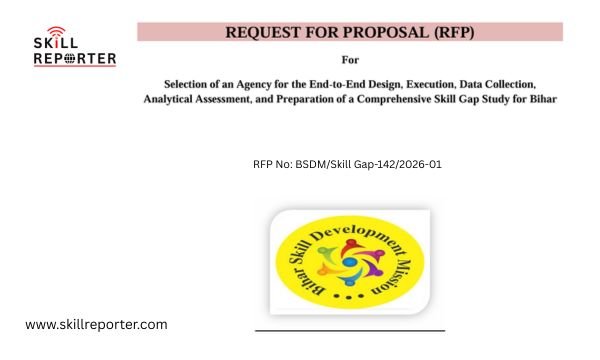
Bihar Skill Development Mission (BSDM) invites request for proposals (RFP) for Selection of an Agency for the End-to-End Design, Execution, Data Collection, Analytical Assessment, and Preparation of a Comprehensive Skill Gap Study for the state of Bihar.
Location of the Project:
Patna,Bihar, India
Eligibility
- The bidder must be a registered Partnership/ LLP/ Company/ Trust/ Society incorporated/ registered at least on or before 01.04.2021. The bidder should be registered with GST and Income Tax Authorities
- The Applicant Organization must have a minimum Average Annual Turnover of at least INR 02 crores(Two Crore)in the three financial years i.e. FY 2022-23, 23-24 & 24-25. The Agency should have Positive Net Worth as on 31st March of three financial years i.e. FY 2022-23, 23-24 & 24-25.
Context:
The Bihar Skill Development Mission (BSDM), Government of Bihar intends to have a comprehensive District-Wise Skill Gap Study. This rigorous study will delve into various facets of the skill development ecosystem, with a particular focus on identifying existing gaps.
The intention is to gain a thorough understanding of the aspirations of the youth and the specific skilling requirements within the state of Bihar. This analysis will span the period from 2026 to 2031 and will consider factors from both the supply and demand sides of the equation. Through this endeavour, the BSDM aspires to design plans and programs which would bridge the skill gap effectively and align the aspirations of the youth with the market demands, thereby fostering a robust and skilled workforce for the future.
The BSDM, Government of Bihar is seeking to hire the expertise of a professional consulting firm to conduct the comprehensive, district-wise Skill Gap Study within a period of 12 months.
Scope of Work & overall Framework for Skill Gap Assessment:
The skill gap assessment should have a robust and comprehensive framework to look at the demand for and supply of skills holistically as well as to forecast the expected changes to prepare the skill ecosystem for the future. The scope of work of the agency will include the following:
- Wireframe: Based on the objectives of the assignment, the agency will develop the technological architecture and wireframe for the tool for data collection and analysis.
- Pilot technical tool: The agency will develop a prototype of technical tool for conducting skill gap analysis. The tool will be operated with small sample data to check its usability.
- Stakeholder consultation: The agency will demonstrate the pilot tool to the government and gather feedback for improving the tool.
- Product development: Based on the feedback, the agency will further refine the technical product to include all functionalities required to meet the objectives listed in the previous section.
- Quality assurance and security testing: The agency will conduct quality and security tests as per relevant guidelines and to meet country and state-specific regulations.
- Conduct the assessment: The agency will conduct one round of assessment by collecting skill supply data from the ITIs and skill demand data from a representative sample of industries.
- Knowledge transfer: The agency will create documentation for conducting the skill gap assessment on an ongoing basis in the state. The documentation should include a comparative analysis of various models of conducting the assessment on regular basis including on cost and effectiveness for various considerations of in-house vs. outsourcing.
- Skill demand assessment: Current levels of skill demand in the industry can be assessed by surveying a sample of the employers, studying sectoral reports, and intelligent systems analysing online job platforms. Analysing various databases, including those on trade and investments, could provide further insights on skill demand. To understand specific skills and skill levels required for various sectors/ job roles, expert consultations can be held. Big data analytics of job descriptions for jobs posted on various platforms could also provide useful insights.
- Hyper Local, National & International Skill demand forecasting: To project the future demand, multiple qualitative and quantitative tools can be utilized to estimate growth rates and employment elasticity. Quantitative methods rely on econometric modelling and statistical analysis, and the qualitative methods include use of sentiment analysis using big data and expert consultations using Delphi method, among others.
- District wise Skill supply assessment: The quality and quantity of skill supply in the economy can be assessed by an analysis of enrolment and completion at education and training institutions along with assessment of graduates of these programs on skill competencies. In addition to technical skills, the graduates can also be assessed on platform skills, soft skills, analytical skills, literacy, etc. to provide comprehensive pictures. Skill assessment at individual level also provides useful input to the learners on further education and employment pathways. The supply side should comprise the sample representation of data from short term skilling, ITI, Diploma, Engineering, General Graduate (BA, BSc., B com.) and school/college dropouts etc.
- Estimate the current skill training capacity of government and private training partners and institutions across various districts in Bihar to project training capacity to be augmented to address the demand.
- Provide recommendations to address the skill gaps and to bolster livelihood generation.
- Identification of Incremental manpower requirements and mapping it with youth aspirations in order to understand and recommend the training needs.
- Creation of demographic profile of all districts including but not limited to total population, age wise and gender- wise population distribution, working age population, employment statistics of the district as well as mapping of vulnerable communities, if any.
- Map the current migration pattern of the state to various states – source locations, role of intermediaries, destination location, placement process and key issues in migration process. The activity needs to be done for both inter-state and intra-state migration.
- Identification of District wise self-employment and entrepreneurship skills potential
- Articulate the aspiration of the youth in various districts by means of a comprehensive survey and map the aspiration to the existing / incremental demand side potential.
- Identify specific type of jobs available in the market along with approximate monthly salary offered and percentage of Trades in which jobs are offered. Level of skill sets required for the available jobs and future jobs. Identify the most employable skills training courses that can be offered under BSDM
- Recommendations on innovative courses/trades that are in demand (with employment potential in organized sector) and are not covered under BSDM/ in the state so far and/or are “new” that is worth exploring.
- Provide holistic implementation plan for development of local communities while taking cognizance of the unorganized sector as well across the districts through skill development and livelihood generation programs.
- Identification of key industries/ units for the priority sectors, in each district. Apart from covering existing industries/ units, the study should also cover emerging and upcoming industries/ units like Agro based industry and food processing over the period of 2026-2033. Trades/ units within the unorganized sector must also be identified and validation of the same with district level representatives.
- Identification of skill requirements for priority sectors and job roles for which maximum migration happens from the state or for which the out of State demand / livelihood generation potential is high.
- Estimation of incremental human resource requirement for the period of 2026-2031 based on Inter Sate migration potential or locations and sectors: This represents the shortage of workers across major functions within identified priority sectors and possible locations which can be met either through new entrants from Bihar or training of the unemployed youth of Bihar to meet short-term sectoral requirements. Up-skilling requirements may also be covered as part of the study.
- Analysis and insights: Periodic data collection on the above three provides rich data on supply and demand of skills in the economy that can be analysed to provide useful insights for graduates, institutions, and policymakers. The analysis will provide an understanding of the skill inventory in the state, skill requirement (present and future projected) in the state, and gaps in skills and skill levels.
- Technology tools: Implementation of a regular skill gap assessment should utilize technology tools for collection and analysis of data. Additionally, AI could be used to supplement some of the data collection, cleaning, and analysis activities. A dynamic dashboard could summarize the results and provide insights for consumption by various stakeholders
Last date for submission:
05 August 2026, 03:00 PM IST