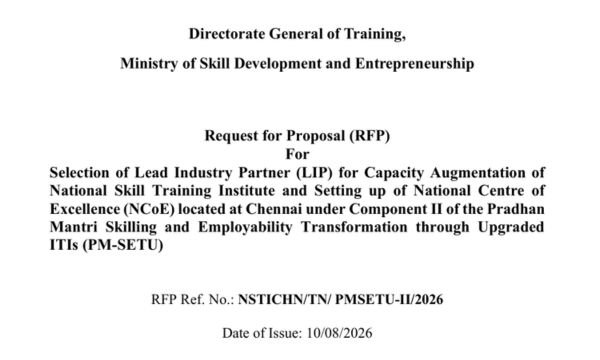
The Regional Directorate of Skill Development & Entrepreneurship (RDSDE), Tamil Nadu, Government of India invites proposals for Selection of Lead Industry Partner (LIP) for Capacity Augmentation of National Skill Training Institute and Setting up of National Centre of Excellence (NCoE) located at Chennai under Component II of the Pradhan Mantri Skilling and Employability Transformation through Upgraded ITIs (PM-SETU)
Objective of the Assignment
The objective of this assignment is to engage a technically competent and credible Lead Industry Partner (LIP) to support the transformation of the identified NSTI into a modern, industry-aligned institution for vocational and instructor training. The assignment also includes the establishment of a National Centre of Excellence (NCoE) as a key and distinct pillar of institutional transformation. The selected LIP shall be responsible for conceptualizing, establishing, and operationalizing the NCoE in collaboration with the IMC and relevant stakeholders, with a focus on advanced skills, global standards, innovation, and sector-specific specialization, thereby strengthening industry alignment, enabling global partnerships, and positioning the NSTI as a world-class hub for skill development.
Eligibility:
- Industry Partners (credible companies or manufacturers with established operations in India), including Public Sector Undertakings
OR
Industry associations or Consortia
OR
Industry-led foundations (CSR/philanthropy arms of corporates) |
OR
Academic institutions promoted/operated by industry (e.g., corporate universities, sectoral skilling institutions) - The Bidder shall not have been blacklisted or debarred by any government department, public sector undertaking, or multilateral agency
- The Bidder shall have an average annual turnover of not less than INR 500 Crore, based on its standalone audited financial statements, during the last three (3) completed financial years preceding the Bid Due Date.
- The Bidder shall have a positive net worth for the last three (3) consecutive financial years, i.e., FY 2022-23, FY 2023-24, and FY 2024-25, as evidenced by audited financial statements.
Scope of Work / Roles and Responsibilities of Lead Industry Partner (LIP)
The selected Lead Industry Partner (LIP) shall constitute the Institute Management Committee (IMC) and lead the comprehensive transformation of the NSTI into a globally benchmarked institute for advanced vocational training and instructor development under PM-SETU, ensuring achievement of the scheme’s objectives.
The LIP is expected to bring strategic leadership, co-investment, technical expertise, industry linkages, and long-term commitment towards upgrading NSTIs and establishing National Centres of Excellence (NCoE) for vocational education and instructor training. The responsibilities of the LIP shall include, but not be limited to, the following:
- Institutional Governance and Strategic Leadership: The LIP shall actively participate in the governance and strategic development of the NSTI through the Institutional Management Committee (IMC). The responsibilities shall include:
- Participation as Chairperson of the Institutional Management Committee (IMC)/Society/Governing Body of the NSTI.
- Providing strategic guidance for institutional transformation, modernization and long term sustainability.
- Contributing to key policy decisions related to academic programs, infrastructure development, industry collaboration, and institutional partnerships.
- Supporting industry-led governance practices and transparent decision-making within the IMC.
- Serving on relevant IMC sub-committees such as Curriculum, Infrastructure, Placement, or Industry Collaboration Committees, as required.
- Preparation of Strategic Investment Plan (SIP): The draft SIP prepared by the LIP shall be reviewed and endorsed by the IMC to ensure alignment with the vision of the NSTI and to incorporate inputs from the Global Partner. During the endorsement process, the IMC shall ensure that the core framework, objectives, and approved interventions outlined in the draft SIP remain unchanged. However, the IMC may incorporate minor corrective measures and rationalization of activities to address implementation challenges, align with evolving industry requirements and technological advancements, and enhance the overall effectiveness and outcome-oriented execution of the PM-SETU Scheme.
Subsequently, the IMC shall submit the endorsed SIP to the National Steering Committee (NSC) for approval. The approved SIP shall guide the implementation of project activities over the entire duration of the Scheme. The SIP shall include, inter alia:
- Institutional vision, mission and transformation roadmap.
- Assessment of existing infrastructure, laboratories, workshops, faculty strength, and training capacity.
- Identification of priority sectors and emerging technologies aligned with industry demand.
- Plan for expansion of training capacity including CTS, CITS and Short term programs and introduction of new courses.
- Plan for upgradation of existing Courses under CTS, CITS and Short term programs.
- Infrastructure modernization plans including laboratories, workshops, digital classrooms, hostels and training facilities.
- Plan for establishment of National Centres of Excellence and other academic centres.
- Human resource development plan including faculty engagement and capacity building.
- Capital expenditure (CAPEX) and operational expenditure (OPEX) projections.
- Implementation timelines and milestones.
- Sustainability and resource mobilization strategies.
- Annual Operational Planning and Implementation Support: The Lead Industry Partner (LIP) through IMC shall be responsible for leading the preparation of Annual Operational Plans (AOPs) for the entire 5-year implementation period under PM-SETU for upgradation of NSTIs. While preparing the Annual Operational Plans (AOPs), the LIP shall ensure that the core framework, objectives, and approved interventions outlined in the SIP remain unchanged; however, the LIP may incorporate minor corrective measures, rationalization of activities, and year-wise reallocation of tasks, as may be required, to address implementation challenges, align with evolving industry requirements and technological advancements, and enhance the overall effectiveness and outcome-oriented execution of the PM-SETU scheme.
- Financial Contribution and Revenue Models: The LIP shall contribute towards the financial sustainability and development of the NSTI. Responsibilities include:
- Contributing a minimum of twenty percent (20%) of the total project outlay, covering both (i) upgradation of NSTIs including civil infrastructure, equipment, and support facilities, and (ii) operational and workforce costs, in accordance with the PM-SETU Scheme Guidelines.
- The contribution shall be made through direct financial transfer to the designated escrow account, and in-kind contributions shall not be considered for meeting the mandatory financial commitment.
- Supporting additional investments for innovation labs, incubation centres, or specialized training facilities.
- Participation in revenue generation models
- Development of Centres of Excellence, Innovation, and Research Collaboration: The LIP through IMC shall support in establishing and operationalizing specialized academic and innovation centres to strengthen the NSTI ecosystem. This includes:
- National Centre of Excellence (NCoE) in high-growth sectors.
- Centre for Industrial Collaboration (CIC) to strengthen industry linkages.
- Centre for TVET Practitioners’ Development for training of trainers.
- Centre for Research, Innovation and Entrepreneurship.
- Infrastructure Development and Lab Setup: The LIP shall lead the capacity augmentation of NSTI through upgrading infrastructure and training facilities. This may include:
- Assessment of existing laboratories, workshops, hostels, and training facilities.
- Identification of modern equipment and technologies required for upgraded programme.
- Development of technical specifications for equipment procurement.
- Design of sector-specific laboratories, workshops, simulators and digital classrooms.
- Preparation of lab upgradation roadmaps.
- Planning of smart classrooms, simulation labs, and digital learning tools.
- Providing access to industry training facilities for practical exposure and internships.
- Curriculum Modernization and Training Delivery: The LIP shall lead the modernization and development of industry-aligned training programme. Responsibilities include:
- Curriculum review and gap analysis of existing CTS and CITS programme.
- Development of 20 long-term and 10 short-term training programme and upgradation of 20 existing training programs aligned with industry needs.
- Integration of modern technologies, digital learning tools and advanced manufacturing practices.
- Alignment of training programs with NSQF/QP-NOS frameworks.
- Development of modular, blended and job-linked training formats.
- Integration of On-the-Job Training (OJT), apprenticeships, and industry exposure.
- Human Resource Development and Faculty Capacity Building: The LIP through IMC shall be responsible for supporting faculty development and strengthening human resource capabilities for effective implementation of the SIP for upgradation of NSTI. This shall include deployment and engagement of appropriate human resources to ensure efficient execution of envisaged interventions. The LIP, through the IMC, shall have the necessary autonomy for engagement of manpower and re-alignment of roles of existing personnel, in line with institutional requirements and scheme objectives.
- Certification, Accreditation and Quality Assurance: The LIP shall facilitate the IMC in establishing robust quality assurance mechanisms. This may include:
- Aligning training programs with NSQF, NCVET and other regulatory standards.
- Supporting development of certification frameworks and co-branded certification models where applicable.
- Conducting institutional quality audits and performance reviews.
- Benchmarking NSTI programs with national and international standards.
- Monitoring, Reporting and Compliance: The LIP is responsible for fulfilling monitoring and reporting requirements under the scheme. Responsibilities include:
- Tracking implementation of SIP and AOP targets.
- Preparation of quarterly progress reports for submission to the National Project Monitoring Unit (NPMU).
- Preparation of annual reports on institutional activities and achievements.
- Supporting financial transparency and audit compliance.
- Global Partnerships and International Collaboration: The LIP, through the IMC, will promote collaboration with global partners and their agencies to strengthen the NSTI ecosystem and support the development of the National Centre of Excellence (NCoE). Advanced manufacturing has been identified as a priority area for NSTI Chennai. A Memorandum of Understanding (MoU) was signed with the Ministry of
Trade and Industry (MTI), Government of Singapore, on 3 September 2025 for the establishment of a National Centre of Excellence in Skilling. The LIP will actively leverage these partnerships to build sector-specific capabilities and enhance global integration.
The LIP and the Global Partner shall jointly ensure that the NCoE is developed as a globally competitive, industry-driven centre for advanced skilling under the Scheme. The roles and responsibilities shall include the following:
Roles and Responsibilities of Lead Industry Partner (LIP):
Shall be primarily responsible for the planning, establishment, and operationalization of the NCoE through the IMC
- Develop infrastructure, deploy advanced equipment, and mobilize financial resources in accordance with Scheme provisions
- Ensure industry-aligned, future-ready training programme and strong industry linkages
- Promote innovation, incubation, entrepreneurship, and industry–academia collaboration
- Facilitate engagement with global partners and agencies
- Support foreign language training programme, where required
- Earmark project funds for global partnerships towards:
- Curriculum development and benchmarking
- Capacity building of trainers
- Industry partnerships and applied research
- Skill certification and global mobility
- Adoption of global best practices
Roles and Responsibilities of Global Partner:
- Provide technical expertise and international best practices
- Support curriculum benchmarking and advanced training methodologies
- Enable technology transfer and alignment with global standards
- Support faculty development, training programme, and international exposure
- Strengthen innovation, research, and industry–academia linkages
- Outreach, Branding and Inclusion: The LIP shall be responsible for strengthening the visibility and outreach of the NSTI, in coordination with the IMC. Activities may include:
- Co-developing branding and outreach strategies.
- Organizing job fairs, skill fairs and employer engagement programs.
- Promoting participation of women, rural youth, persons with disabilities and underserved communities.
- Supporting awareness campaigns for vocational training programs.
Last date for submission:
25 September 2026, 06:00 PM IST
Read Full RFP and Application Process, Click Here

