Pradhan Mantri Skilling and Employability Transformation through Upgraded ITIs (PM-SETU) Scheme is one of the Government of India’s most significant recent interventions aimed at modernising the country’s Industrial Training Institute (ITI) ecosystem.
With an estimated investment of ₹60,000 crore over five years, the scheme seeks to upgrade 1,000 Government ITIs and strengthen five National Skill Training Institutes (NSTIs) as National Centres of Excellence for skilling.
But PM-SETU is not simply an infrastructure-modernisation programme.
Its more important ambition is to change how ITIs function—from institutions largely focused on delivering prescribed trades to institutions that are more closely connected to industry demand, modern technology, apprenticeships, employment and local economic opportunities.
The scheme was formally launched by Prime Minister Narendra Modi on 4 October 2025 at Vigyan Bhawan, New Delhi, after receiving Union Cabinet approval on 7 May 2025.
So, what exactly is PM-SETU? Who will benefit? How will the model work? What role will industry play? And, importantly, can upgrading ITI infrastructure actually translate into better employment outcomes?
Here is a detailed look.
What is PM-SETU?
PM-SETU stands for Pradhan Mantri Skilling and Employability Transformation through Upgraded ITIs.
It is a Centrally Sponsored Scheme of the Ministry of Skill Development and Entrepreneurship (MSDE), implemented through the Directorate General of Training (DGT), with State/UT Governments and industry playing important roles.
The scheme emerged from the Government’s broader effort to strengthen vocational education and make India’s skilling system more responsive to the changing requirements of employers.
The PM-SETU guidelines describe its central idea as creating “government-owned, industry-managed” aspirational ITIs capable of delivering demand-driven training and better employment outcomes.
That phrase is important.
Traditionally, ITIs have largely operated within government administrative structures. PM-SETU attempts to bring industry much closer to the management, curriculum, equipment, training delivery, apprenticeships and employment outcomes of upgraded institutions.
Why was PM-SETU needed?
India has a very large vocational training network. According to the Government, the number of ITIs increased from 9,776 in 2014 to 14,682 by 2025. At the same time, the share of young people aged 15–29 receiving vocational training increased from 7.1% in 2017–18 to 26.1% in 2023–24.
However, expansion in the number of institutions does not automatically mean that the institutions are producing the skills employers need. The underlying challenge is more complicated.
Technology is changing rapidly. Manufacturing is becoming more automated. Electric mobility, renewable energy, semiconductors, artificial intelligence, robotics, industrial IoT and digital technologies are creating new occupational requirements.
An ITI student trained on outdated equipment or with limited exposure to contemporary workplaces can possess a formal qualification but still struggle to become job-ready.
PM-SETU therefore attempts to address several problems simultaneously:
- outdated or inadequate equipment;
- mismatch between training and industry requirements;
- insufficient industry participation;
- limited exposure to actual workplaces;
- need for new-age trades;
- weak apprenticeship and placement linkages;
- trainer capability gaps;
- limited opportunities for continuing and short-term learning; and
- inadequate institutional mechanisms for responding quickly to changing labour-market requirements.
The official PM-SETU objectives explicitly include improving training quality, modernising infrastructure, introducing industry-aligned courses, strengthening industry linkages and improving the capacity of NSTIs for training trainers.
How much money has been allocated to PM-SETU?
The scheme has a total estimated outlay of ₹60,000 crore for five years.
The financing structure is:
Funding Source (Amount in INR)
Central Government ( ₹30,000 crore )
State Government ( ₹20,000 crore )
Industry ( ₹10,000 crore )
Total ( ₹60,000 crore )
Importantly, 50% of the Central Government’s share is co-financed equally by the Asian Development Bank (ADB) and the World Bank through result-based loans, according to the official PM-SETU guidelines.
This makes PM-SETU significantly different from a conventional government infrastructure scheme.
It is designed around shared financial responsibility and shared institutional responsibility.
What exactly will PM-SETU upgrade?
PM-SETU has two major components:
| Component I | Component II |
|---|---|
| Upgradation of 1,000 Government ITIs The largest component covers 1,000 Government ITIs. These will be organised into: 200 Hub ITIs 800 Spoke ITIs The basic design is approximately one Hub for every four Spoke ITIs. What is a Hub ITI? A Hub is intended to become the stronger institution within the cluster. It can have: * advanced machinery and equipment; * modern laboratories; * smart classrooms; * digital learning systems; * new-age courses; * innovation and incubation facilities; * production centres; * training-of-trainers facilities; * placement services; * apprenticeship and industry linkages; * counselling and student-support services; and * advanced training capabilities. What is a Spoke ITI? Spoke ITIs are intended to extend access to surrounding areas and connect learners in smaller towns and other regions to the upgraded ecosystem. This is particularly relevant because simply concentrating advanced infrastructure in a few large cities could widen the geographical divide in access to quality vocational training. The hub-and-spoke model attempts to combine specialisation with geographical reach. | Capacity Augmentation of 5 National Skill Training Institutes (NSTIs) and Setting up of 5 National Centres of Excellence for Skilling The second component focuses on strengthening five National Skill Training Institutes (NSTIs): * Bhubaneswar, Odisha * Chennai, Tamil Nadu * Hyderabad, Telangana * Kanpur, Uttar Pradesh * Ludhiana, Punjab These institutions are intended to be strengthened as sector-specific National Centres of Excellence (NCoEs) with global partnerships. A major objective is advanced training of trainers, along with curriculum development and advanced skilling capabilities. This component is important because upgrading equipment without upgrading the people who operate and teach on that equipment would produce only partial reform. |
The most important feature: industry-led management
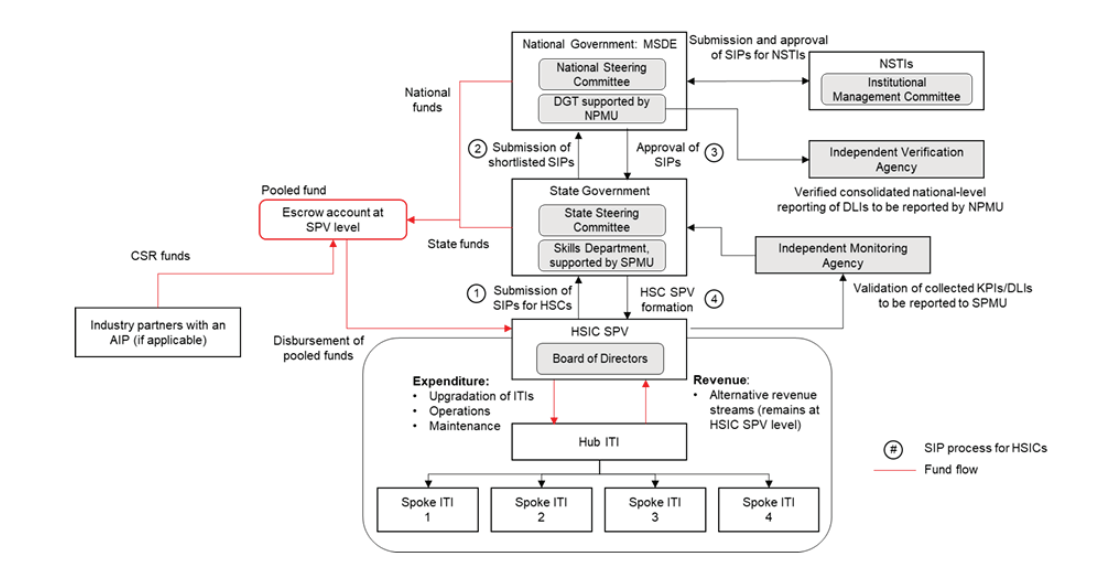
Perhaps the most distinctive feature of PM-SETU is its proposed industry-led Special Purpose Vehicle (SPV) model.
For each cluster, a credible Anchor Industry Partner (AIP) is selected through a State-led process. After approval of the Strategic Investment Plan, the selected industry partner is required to establish an SPV for the cluster.
Under the industry-led model described in the official guidelines:
- 51% of the SPV shareholding is held by the Anchor Industry Partner;
- 49% is equally shared by the Central and State Governments.
The SPV receives significant autonomy over areas such as course offerings, curriculum and pedagogy, trainer management and financial operations, within the framework of the scheme.
This is a major shift in philosophy.
The idea is essentially: Government provides the public institutional framework and substantial financing; industry brings market knowledge, technology, operational capability and employment linkage.
Who is an Anchor Industry Partner?
The PM-SETU guidelines allow several types of organisations to participate, including:
- credible companies or manufacturers with established operations in India;
- Public Sector Undertakings;
- industry associations or consortia;
- industry-led foundations; and
- industry-promoted or industry-operated academic/training institutions.
States and UTs can establish additional eligibility conditions depending on their industrial context.
This flexibility is important because the industrial ecosystem of a semiconductor cluster will obviously differ from that of a textile, automotive, tourism or agricultural-processing cluster.
What will students actually study?
PM-SETU does not intend to simply put new machines into old courses.
The guidelines provide for both new courses and redesign of existing courses.
At Hub ITIs, the indicative design provides for an average of:
- 4 new courses
- 10 upgraded existing courses
At Spoke ITIs, the indicative design provides for:
- 2 new courses
- 8 upgraded existing courses
The scheme also allows:
- long-term diploma programmes;
- short-term courses of around 3–6 months;
- executive education programmes;
- specialised short-term courses for non-ITI candidates;
- courses for engineering and diploma students; and
- programmes for working professionals.
This opens the possibility of an ITI becoming more than a place where a young person completes one traditional trade and leaves. A successful PM-SETU institution could potentially become a local lifelong skills centre serving students, workers, employers and entrepreneurs.
What are the new-age skills under the scheme?
The Government reported in August 2026 that 32 new-age courses had been introduced under the Craftsmen Training Scheme.
They cover areas including:
- Artificial Intelligence;
- Cybersecurity;
- Data annotation;
- Drones;
- 3D printing;
- Advanced CNC machining;
- Industrial robotics;
- Industrial IoT;
- Green hydrogen;
- Electric vehicles;
- Semiconductors;
- Solar technology;
- Mechatronics;
- Software testing;
- 5G;
- Wind energy; and
- Nuclear power.
The complete list includes 32 trades/courses.
This is one of the clearest signals of the direction PM-SETU is taking: traditional vocational education is being pushed toward emerging industrial technologies without completely abandoning conventional trades.
PM-SETU is not only about technology
This is an important distinction. A modern ITI cannot be created simply by buying expensive machines.
The PM-SETU guidelines also provide for:
- Apprenticeships;
- On-the-Job Training (OJT);
- Placement services;
- Counselling;
- Remedial education;
- Life skills;
- Industry exposure;
- Trainer development;
- Incubation;
- Production centres;
- Maker spaces;
- Digital learning;
- Simulation;
- AR/VR capabilities; and
- Real-time learning-outcome management.
The scheme also envisages a digital interface and Learning Outcome Management System (LOMS) to capture data and connect the ITI ecosystem with national datasets and the Skill India Digital Hub.
This is crucial because employability is rarely determined by classroom training alone.
Who will benefit from PM-SETU?
The immediate beneficiaries are students and trainees in the upgraded ITIs.
But the potential beneficiary group is much larger.
- ITI students
They should gain access to better infrastructure, equipment, curriculum, industry exposure and employment opportunities. - Non-ITI learners
The scheme allows specialised short-term programmes for engineering students, diploma holders and working professionals. - Working professionals
Hub ITIs can potentially offer executive education and short-term programmes using advanced facilities. - Employers
Companies can gain access to a more relevant local talent pipeline. - Trainers
The model provides stronger opportunities for trainer development and industry exposure. - Local economies
Upgraded ITIs can potentially become local centres for apprenticeships, production, entrepreneurship and industry-linked training. - Students in smaller towns and aspirational districts
The spoke model is particularly important here because it seeks to extend the benefits of upgraded training beyond a limited number of large urban institutions.
How will PM-SETU be implemented?
Implementation is designed as a multi-level process.
Step 1: States identify ITIs
State/UT Governments identify ITIs in consultation with industry, taking into account factors such as emerging skill requirements and local industrial potential.
Step 2: Industry participation is invited
States invite industry through an Expression of Interest or Request for Proposal.
Step 3: Industry submits a Strategic Investment Plan
The interested Anchor Industry Partner proposes how it will transform and manage the ITI cluster.
The SIP is evaluated on areas such as:
- human resources;
- employment outcomes;
- operational strategy;
- curriculum;
- infrastructure;
- industry linkages; and
- sustainability.
Step 4: State-level evaluation
The State Steering Committee evaluates proposals and forwards eligible proposals.
Step 5: National approval
The National Steering Committee reviews and approves the Strategic Investment Plan.
Step 6: SPV formation
After approval, the selected industry partner forms the industry-led SPV.
Step 7: Implementation and monitoring
The SPV leads the implementation of the approved transformation plan, while the government retains oversight through the scheme’s governance architecture.
The official guidelines initially envisaged a phased pilot covering around 20–25 Hub-and-Spoke clusters, representing approximately 100–125 ITIs, before scaling up.
What is the role of the National and State Steering Committees?
PM-SETU does not leave implementation entirely to industry.
A National Steering Committee (NSC) provides overall policy direction and considers Strategic Investment Plans whereas, at the State level, State Steering Committees oversee implementation and facilitate the selection of industry partners and ITIs.
The Government has also stated that implementation will involve periodic monitoring, performance reviews and third-party impact assessment.
This creates an important balance: industry gets operational influence, but public authorities remain responsible for governance and accountability.
Where does PM-SETU stand now?
This is where you need to distinguish between scheme ambition and implementation evidence.
PM-SETU was launched in October 2025. By August 2026, the Government reported that seven Strategic Investment Plans had been approved.
These covered:
- Andhra Pradesh – 1 cluster
- Odisha – 1 cluster
- Gujarat – 1 cluster
- Telangana – 3 clusters
- Rajasthan – 1 cluster
Together, these represent seven approved clusters involving the respective Hub and Spoke ITIs.
In July 2026, the National Steering Committee had approved the transition from the pilot phase toward nationwide rollout across the 200 identified ITI clusters. The Government also reported approved SIPs with a combined proposed investment of ₹1,237.58 crore at that stage.
The first approved PM-SETU SIP was the Visakhapatnam ITI Cluster in Andhra Pradesh, with ArcelorMittal Nippon Steel India as Anchor Industry Partner and New Age Makers Institute of Technology as academic partner.
Therefore, as of September 2026, PM-SETU has clearly moved beyond announcement into implementation—but it is far too early to claim that the scheme has already transformed India’s ITI system or demonstrated large-scale employment impact.
That distinction matters.
What could PM-SETU do differently?
The scheme has several potentially strong design features.
1. It puts industry closer to the training process
One of India’s longstanding skilling challenges has been the distance between training institutions and employers. PM-SETU attempts to reduce that distance structurally.
2. It focuses on outcomes, not only infrastructure
The guidelines explicitly refer to employment outcomes, apprenticeships, placements and industry linkages. That is the right direction.
An ITI should not be judged only by: How many students completed training?
It should increasingly be judged by: How many became employable? How many got jobs? What wages did they earn? Did they retain those jobs?
3. It creates a mechanism for continuous curriculum change
The Government says curriculum review will consider emerging technologies, occupational standards, industry demand, employability trends, apprenticeship requirements and training outcomes. This is important in an economy where occupational requirements can change faster than conventional curriculum cycles.
4. It recognizes trainers as part of the reform
The five NCoEs and Hub ITIs are expected to strengthen training-of-trainers capacity. Without this, sophisticated equipment can quickly become underutilized.
5. It attempts to build local skill ecosystems
The Hub-and-Spoke approach can connect multiple ITIs with industry, trainers, apprenticeships, technology and employers within a regional ecosystem.
What should success look like?
This may be the most important question surrounding PM-SETU.
If success is measured only by:
- number of ITIs upgraded;
- money spent;
- laboratories established;
- machines purchased;
- number of new courses introduced;
the scheme could appear successful without necessarily improving livelihoods.
A stronger evaluation framework should look at:
- Access: How many learners are actually enrolling?
- Completion: How many complete their programmes?
- Competency: Can they demonstrate the required occupational skills?
- Apprenticeship: How many receive meaningful workplace exposure?
- Placement: How many secure employment?
- Wage: What is their starting wage compared with non-PM-SETU ITI graduates?
- Retention: How many remain employed after 6, 12 and 24 months?
- Career progression: Do their earnings and responsibilities increase?
- Employer satisfaction: Would employers hire PM-SETU graduates again?
- Trainer quality: Are trainers themselves continuously upgrading their skills?
- Industry participation: Is industry actively involved in curriculum, training and placements—or primarily in governance and funding?
These indicators would provide a much stronger measure of whether PM-SETU is actually delivering its stated employability objective.
PM-SETU in one picture
The scheme can essentially be understood as:
Government investment
↓
1,000 Government ITIs
↓
200 Hubs + 800 Spokes
↓
Industry-led SPVs
↓
Modern infrastructure + new-age courses
↓
Better trainers + industry exposure
↓
Apprenticeships + OJT + placement support
↓
Higher employability
↓
Better jobs and career progression
The final two steps are where the real test lies.
What does PM-SETU mean for an ITI student?
For a student, the scheme could eventually mean access to:
- more modern equipment;
- industry-relevant courses;
- emerging technology trades;
- better practical training;
- industry exposure;
- apprenticeships;
- placement support;
- counselling;
- short-term upskilling opportunities; and
- potentially better connections with employers.
But students should also understand that PM-SETU is not a direct employment guarantee scheme.
Being enrolled in an upgraded ITI will not by itself guarantee a job.
The scheme is designed to improve the quality and relevance of the training ecosystem; employment outcomes will still depend on the student’s competency, labour-market demand, employer requirements and the quality of implementation at the individual ITI.
What does PM-SETU mean for industry?
For companies, PM-SETU offers an opportunity to move beyond the traditional model of saying:
“Training institutions are not producing the people we need.”
Instead, industry gets a mechanism to participate more directly in:
- curriculum design;
- training delivery;
- infrastructure planning;
- trainer development;
- apprenticeships;
- workplace exposure;
- innovation;
- placement;
- and institutional management.
This could make the ITI ecosystem significantly more demand-driven—provided companies participate as long-term ecosystem partners rather than short-term project sponsors.
The bigger picture
India’s skilling challenge has never been simply about the number of people trained. India has trained millions of people through different government and private programmes.
The harder question has always been:
Are people acquiring skills that employers actually value—and are those skills translating into sustainable livelihoods?
PM-SETU attempts to address this question at the institutional level.
Instead of creating another standalone short-term training programme, it seeks to change the infrastructure, governance, curriculum, trainer ecosystem, industry linkage and employment orientation of ITIs themselves.
That makes the scheme strategically important. But it also makes implementation much harder.
Key PM-SETU facts at a glance
| Particular | Details |
|---|---|
| Full name | Pradhan Mantri Skilling and Employability Transformation through Upgraded ITIs |
| Scheme type | Centrally Sponsored Scheme |
| Nodal Ministry | Ministry of Skill Development and Entrepreneurship (MSDE) |
| Implementation ecosystem | DGT, State/UT Governments and Industry |
| Cabinet approval | 7 May 2025 |
| Launch | 4 October 2025 |
| Launched by | Prime Minister Narendra Modi |
| Total outlay | ₹60,000 crore |
| Implementation period | 5 years |
| Central share | ₹30,000 crore |
| State share | ₹20,000 crore |
| Industry share | ₹10,000 crore |
| Government ITIs targeted | 1,000 |
| Hub ITIs | 200 |
| Spoke ITIs | 800 |
| NSTIs/National Centres of Excellence | 5 |
| Indicative cluster structure | 1 Hub + around 4 Spokes |
| Industry governance model | Industry-led SPV |
| AIP share in industry-led SPV | 51% |
| Central + State share in SPV | 49% |
| New-age CTS courses reported by Aug. 2026 | 32 |
| Approved SIPs as of 10 Aug. 2026 | 7 |
| Approved clusters as of 10 Aug. 2026 | Andhra Pradesh, Odisha, Gujarat, Telangana and Rajasthan |
Sources:
- PM-SETU Scheme Guidelines Component I
- PM-SETU Scheme Guidelines Component II
- PM launches PM-SETU on 4 October 2025
- ITI Upgradation and Industry Alignment under PM-SETU, 10 August 2026
- PM-SETU nationwide rollout and ₹1,237.58 crore SIP approvals
- First PM-SETU Strategic Investment Plan approved in Andhra Pradesh
- Five National Centres of Excellence under PM-SETU
Other Important Links on PM-SETU