SKILLREPORTER | POLICY ANALYSIS
India’s Skilling System Needs More Than More Training
What NITI Aayog’s Viksit Bharat@2047 Report Proposes
An editorial reading of the key findings, numbers, reforms and implementation priorities emerging from NITI Aayog’s “Reimagining Skilling for Viksit Bharat@2047”.
India’s skilling ecosystem has expanded significantly over the past decade. Since 2014-15, more than 7.67 crore individuals have been formally skilled, while the Union Budget for FY2025-26 allocated ₹34,000 crore in skilling-related expenditure across key Central Ministries. Yet, NITI Aayog’s latest report argues that expansion alone is not enough. Outcomes remain uneven, and the changing nature of work is forcing a rethink of how Indians learn, acquire skills, enter employment and progress through their careers.
The report, “Reimagining Skilling for Viksit Bharat@2047,” prepared by NITI Aayog’s Skill Development, Labour and Employment Division, makes a fundamental proposition: India needs to move from a system of episodic training to a lifelong skilling architecture centred on the learner.
The shift is significant.
The question is no longer simply how many people can be trained. It is whether people can identify the right pathway, access it, afford it, acquire practical and relevant capabilities, get those capabilities recognised, find work and continue to progress as the economy changes.
That is the central logic running through the report.
The scale of the challenge
To understand India’s skilling needs, NITI Aayog looks beyond a single “skill gap” and examines five learner and worker segments representing approximately 60 crore people:
- 12 crore school students from Grade 6 onwards
- 4.4 crore learners in higher education, technical education and ITIs
- 7 crore people in formal non-agricultural employment
- 27 crore people in informal non-agricultural employment
- Women and NEET youth as cross-cutting and priority segments.
The report notes that India’s labour force stood at 65.4 crore, while 79.6 crore people were outside the labour force in the cited data. Among the labour force, 58.4% were self-employed, 21.7% were regular wage/salary workers and 19.8% were casual labourers.
This diversity matters.
A school student deciding whether to pursue a vocational pathway, an ITI graduate seeking progression, an informal worker who cannot afford to lose a day’s wages, a woman constrained by safety and caregiving responsibilities, and a worker whose occupation is being reshaped by technology cannot be served effectively through one standard training model.
The report therefore builds its case around the learner’s journey rather than around individual schemes.
1. The diagnosis: five barriers are holding the system back
The report identifies five recurring barriers across learner segments:
- Information and value perception
- Access
- Funds
- Learning and delivery models
- Structure and governance
Together, these barriers explain why skilling often fails to translate into employability, progression and sustainable livelihoods.
1.1 Information is still a major barrier
One of the report’s strongest findings is that many people do not know what to learn, where to learn, which programmes are credible, what employers value, or what returns they can realistically expect.
The problem begins early. Career choices are often influenced by marks, family preferences, social perceptions and the prestige attached to degrees rather than by aptitude, interests or labour-market opportunities.
The report cites survey findings showing that lack of awareness of the right programmes was among the top three reasons for not pursuing skilling for:
47% of women, 43% of NEET youth, 36% of higher-education students, 52% of formal workers and 55% of informal workers.
The consequences can be significant.
Based on the cited BCG Higher Education Survey, generic undergraduate graduates who had undertaken skilling reported an average starting salary of ₹29,000 per month, compared with ₹22,000 per month for those without additional skilling. At the assumed annual growth rate used in the analysis, the report estimates that this difference could amount to approximately ₹9.7 lakh over 10 years. NITI Aayog also cautions that this is based on a limited sample and calls for wider, systematic outcome data.
What needs to change
The report proposes making guidance a permanent layer of the skilling system through:
-
- Counselling in schools and colleges
- Trusted community-level guidance
- Digital career tools
- Credible course and provider discovery
- Better information on apprenticeships and government schemes
- Transparent information on career outcomes.
The underlying idea is simple: people cannot make better skill choices if they cannot see the choices clearly.
2. Access: wanting to skill is not enough
The second barrier is physical, financial and practical access.
In schools, early exposure to vocational education remains limited. The report notes that fewer than 1 in 12 secondary schools were offering vocational subjects, despite the direction set by NEP 2020.
For higher-education learners, practical exposure and meaningful industry engagement remain uneven.
For workers, particularly those in informal employment, attending training may mean sacrificing income. Fixed schedules, long course durations and limited local options make learning difficult to combine with work.
Women face additional constraints around: distance, safety, transport, caregiving, time and flexibility.
The report’s analysis finds that around 75% of women prefer programmes within a 5-km radius, while 68% prefer part-time courses.
The implication is important: access should not be measured simply by whether a training centre exists.
A programme is not genuinely accessible when the learner cannot reach it safely, cannot afford to lose income to attend it, or cannot fit it around work and family responsibilities.
What needs to change
NITI Aayog points towards:
-
- Flexible and modular training
- Part-time and hybrid formats
- Local and hyperlocal opportunities
- Safe transport and hostels
- Childcare and support infrastructure
- Work-integrated learning
- Flexible employment opportunities alongside learning.
3. Affordability is bigger than course fees
The third barrier is finance.
The report makes an important distinction: the cost of skilling is not just the course fee.
It can include:
fees + travel + living costs + lost wages + the opportunity cost of leaving work.
This becomes especially serious for informal workers and low-income learners.
For someone earning on a daily basis, a week away from work to attend training can be unaffordable even if the course itself is subsidised.
What needs to change
The report proposes moving towards outcome-based financing, supported by instruments such as:
-
- Targeted skill vouchers
- Scholarships for priority groups and sectors
- Placement-linked loans
- Financing linked to verified employment outcomes
- Pay-for-results mechanisms such as Skill Impact Bonds.
The larger policy shift is from asking “How many people received financial support?” to asking “Did the support help the learner achieve a meaningful outcome?”
4. The quality problem: learning does not always translate into capability
The fourth barrier concerns how learning is delivered.
The report finds persistent gaps between education and workplace requirements, including:
- Outdated curricula
- Limited practical exposure
- Weak industry integration
- Insufficient internships and apprenticeships
- Weak job-readiness support
- Limited proof of work
- Insufficient entrepreneurship pathways.
In higher education, the report cites 80% of students identifying lack of practical experience and industry exposure as a major problem. It also notes that 47% of formal workers identified lack of prior experience or internships as their top challenge in finding new jobs.
The report also highlights a deeper demand-side mismatch: training can exist without sufficiently strong links to the actual jobs available in a local economy.
What needs to change
The system needs to move towards:
industry demand → practical learning → workplace exposure → demonstrable capability → employment/progression.
This is why apprenticeships, work-integrated degrees, industry-backed programmes, portfolios and skills-first hiring feature so prominently in the proposed architecture.
5. Structure and governance: the ecosystem itself needs to work better
The fifth barrier is systemic.
The report points to:
- Fragmented programmes across ministries
- Duplication of efforts
- Weak Centre-State convergence
- Underused infrastructure
- Degree-based hiring norms
- Insufficient incentives for industry participation
- Uneven adoption of the National Credit Framework
- Weak coordination across delivery channels.
The problem is therefore not simply a shortage of programmes. The system itself is fragmented.
A learner may encounter one portal for training, another for jobs, another for apprenticeships, another for academic credits and another for employment records—with little continuity between them.
What needs to change
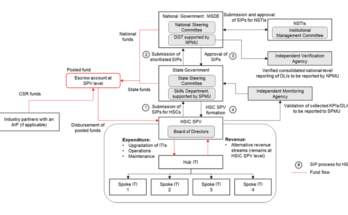
The report proposes stronger convergence, skills-first hiring, shared infrastructure, portable credentials, better data systems and clearer roles for governments, institutions and employers.
This leads directly to the five core reforms.
6. Five reforms that define the proposed new direction
NITI Aayog’s response is not another long list of disconnected schemes. It identifies five core reforms aimed at changing how the ecosystem works.
Reform 1: Integrate skills into schools
The report proposes that skilling should begin before young people have already made narrow career choices.
It proposes General Employability and Entrepreneurship Skills (GEES) from Grade 6 to Grade 12, alongside structured Kaushal Tracks from Grade 9 onwards for deeper vocational specialisation.
The proposed model includes different school archetypes, allowing students to move between academic and vocational options rather than treating vocational education as a one-way choice.
The intended shift
From: vocational education as an alternative or last resort
To: employability and skills exposure as a normal part of schooling.
Reform 2: Make higher education more industry-linked
The report calls for stronger Public-Private Partnership and private-sector engagement in technical and higher education.
The proposed direction includes:
- Industry-aligned specialisations
- Work-integrated degrees
- Apprenticeship Embedded Degree/Diploma Programmes
- Modular and flexible learning
- Earn-while-you-learn options
- Stronger internships
- Greater industry involvement in curriculum and delivery
- Better progression between ITIs, diplomas and degrees.
The underlying message is clear:
Industry should help shape learning, not simply receive graduates at the end of it.
Reform 3: Make skilling outcome-linked and industry-backed
The report proposes a decisive move away from enrolment-focused delivery.
The key question should become:
What happens after training?
Programmes should be aligned with high-growth and emerging sectors, including areas such as green industries and electric vehicles, while also supporting reskilling for declining occupations.
The report proposes stronger industry co-creation, practical delivery, use of existing infrastructure and outcome-linked financing.
Outcomes such as placement, wage improvement and retention should increasingly matter in programme design and funding.
This is arguably the report’s clearest challenge to the existing skilling model:
Training numbers are inputs. Employment and progression are outcomes.
Reform 4: Make apprenticeship a mainstream pathway
India already has apprenticeship schemes, but access is fragmented and awareness remains uneven.
The report proposes a unified State-led apprenticeship platform bringing together different apprenticeship and internship opportunities, with clearer information for both employers and learners.
It also highlights the need to increase participation among MSMEs, which currently engage a relatively small proportion of the potential apprentice base cited in the report.
The intended shift is from seeing apprenticeship as an additional programme to recognising it as a mainstream transition from learning to work.
Reform 5: Make guidance and perception-building continuous
The report argues that guidance cannot be an occasional career-counselling session.
It proposes a multi-channel system covering:
- Schools
- Colleges
- Communities
- Digital platforms
- Women-focused support networks.
One specific proposal is a benchmark of at least one qualified counsellor for every 10 schools, supported initially by civil-society organisations where required and eventually through direct recruitment.
The report also proposes perception-building campaigns such as Hunar Utsav, using role models, local success stories and “try-a-trade” experiences to reposition skilling as a credible and aspirational choice.
7. Four enablers that could make the reforms work
The five reforms require supporting changes to the underlying system. NITI Aayog identifies four.
Enabler 1: Digital Skills Passport
The proposal is to give every learner and worker a Digital Skills Passport/Account linked to APAAR, containing verified credentials, Recognition of Prior Learning credits and work experience.
The learner should be able to use this verified information, with consent, for:
jobs + further learning + financing.
The report also proposes State-level Skills Data Exchanges that bring together information on training supply, infrastructure, local demand, wages, jobs, apprenticeships and outcomes.
The wider ecosystem could include tools such as:
- MyCV for verified CVs
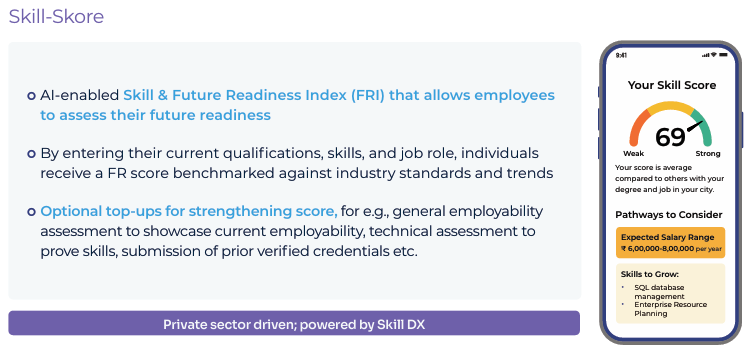
- Skill Skore for skills readiness
- Workfolio for blue-collar and informal workers
- Skill Sure/Skill Scout for course and provider discovery
- LocalWorks for hyperlocal jobs
- National Career Outcome Repository for employment and salary information.
The principle is straightforward:
A learner’s skills should not disappear when the learner changes institution, occupation or location.
Enabler 2: Outcome-based financing
Financial support should increasingly follow outcomes rather than enrolment.
The proposed instruments include:
- Targeted skill vouchers
- Placement-linked financing
- Pay-for-results models
- Skill Impact Bonds.
This could also allow learners more choice in selecting relevant programmes while making providers more accountable for results.
Enabler 3: Make NCrF a real mobility mechanism
The National Credit Framework has the potential to make learning cumulative.
But the report makes an important point: merely accumulating credits is not enough.
Credits need to be recognised and usable for progression.
That means making it easier for learners to move between:
school → ITI → diploma → degree → apprenticeship → work → further learning.
It also means recognising relevant work experience and enabling re-entry through mechanisms such as Open Schooling and Recognition of Prior Learning.
Enabler 4: Skills-first policies and shared infrastructure
The report argues that training reform will have limited impact if employers continue to screen candidates primarily through degrees.
It proposes skills-first approaches including:
- Competency-based job descriptions
- Practical assessments
- Recognition of skills certifications
- Greater recognition of relevant experience.
It also proposes mapping and enabling shared use of existing laboratories, workshops, training centres, hostels and other infrastructure rather than building parallel assets.
Implementation is proposed through a district-first approach, with States providing coordination and district and local institutions playing a stronger execution role.
8. Women cannot be treated as an afterthought
One of the report’s important features is that women are treated as a cross-cutting segment rather than simply another beneficiary category.
The report notes that only 3% of women in the analysed segments were in formal jobs, while 71% were in informal work or the NEET segment.
The response therefore goes beyond “more training”.
It combines:
proximity + flexible learning + safety + mobility + childcare + guidance + finance + flexible work.
This is an important shift in design thinking.
For many women, the question is not simply:
“Is training available?”
It is:
“Can I realistically participate and then use this skill in a safe, sustainable and economically meaningful way?”
9. The bigger shift: from a training system to a lifelong learning system
The report ultimately proposes a Reimagined Skilling Architecture built around three principles:
Non-linear pathways
People should be able to move between education, skilling and work instead of following one fixed route.
Lifelong learning
Learning should continue across working life as jobs and technologies change.
Outcomes as the measure of success
The primary measures should be: employability, progression and livelihoods.
In simple terms, the proposed journey is: Learn → Work → Earn → Progress → Reskill → Move → Learn again
rather than: Study → Get a certificate → Search for a job
10. What happens next?
The proposed architecture gains greater significance because the report links it with the Integrated Scheme in Skilling Architecture (ISSA) announced in the Union Budget 2026-27.
The report notes an allocation of ₹600 crore to MSDE in FY2026-27 for the Central Sector Scheme and identifies State Skills Transformation Pilots in:
Andhra Pradesh, Odisha, Uttar Pradesh, Bihar and Assam.
This makes the next phase particularly important.
The architecture now needs to move from concept to implementation.
That means asking practical questions:
For Governments
Can schemes, budgets, data and departments actually work together?
For States
Can the national framework be adapted to district-level labour-market realities?
For Industry
Will employers move beyond consultation and genuinely co-own curriculum, apprenticeships, infrastructure, assessment and outcomes?
For Training Providers
Can delivery become more flexible, practical, measurable and demand-led?
For Institutions
Can degrees, diplomas, apprenticeships, credits and work experience become genuinely connected?
For Learners
Will the system make career choices easier, learning more accessible and skills more valuable in the labour market?
These questions will ultimately determine whether the proposed architecture becomes a meaningful reform or another layer of programmes and platforms.
SkillReporter View: What will determine implementation?
NITI Aayog’s report is ambitious, but its most important test will not be the number of recommendations adopted on paper.
The real test will be whether the system changes what a learner experiences.
A learner should eventually be able to answer five questions with confidence:
What should I learn?
Where can I learn it?
Can I afford and manage it?
Will employers value it?
What can I do next after I learn it?
The report attempts to build an architecture around these five questions.
That is perhaps its most important contribution.
It shifts the discussion from “How do we train more people?” to “How do we build a system in which people can continuously make better learning and work decisions?”
For India’s skilling ecosystem, that is a much larger ambition.
12 shifts to remember from the report
| From | Towards |
|---|---|
| Training numbers | Employment and progression outcomes |
| Standalone schemes | Integrated skilling architecture |
| Degree-first hiring | Skills-first hiring |
| Linear education pathways | Non-linear, flexible pathways |
| One-time training | Lifelong learning |
| Classroom-heavy learning | Work-integrated learning |
| Apprenticeship as an add-on | Apprenticeship as a mainstream pathway |
| Occasional counselling | Continuous career guidance |
| Certificates as endpoints | Portable, stackable learning |
| Fragmented infrastructure | Shared infrastructure |
| Central programme design | State-led, localised implementation |
| Industry consultation | Industry co-ownership |
The bottom line
NITI Aayog’s Reimagining Skilling for Viksit Bharat@2047 is not primarily a call for another expansion of training.
It is a call to redesign the entire learning-to-livelihood journey.
Its proposed architecture rests on:
5 Core Reforms
4 System Enablers
5 Learner Segments
1 central principle — put the learner at the centre
And its ultimate test is simple:
Can India build a skilling system in which people can learn, earn and advance throughout their working lives?
As the report itself concludes, the success of this vision will depend on coordinated action by governments, institutions and employers, with States serving as the primary drivers of transformation and industry playing a central role in implementation.
Source
NITI Aayog (2026), Reimagining Skilling for Viksit Bharat@2047, August 2026. The report notes that its analysis draws on multiple datasets and research sources and cautions that NITI Aayog does not independently confirm the authenticity of all compiled data or the accuracy of every methodology used.
Editorial note: This article is a SkillReporter analysis of the NITI Aayog report. Statements attributed to NITI Aayog reflect the report; the “SkillReporter View” section represents editorial interpretation and is clearly separated from the report’s stated findings and proposals.
Want to read the complete report, click here