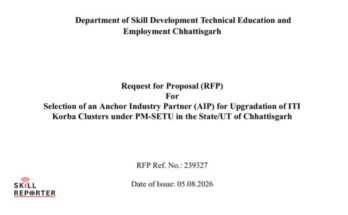

Directorate Employment and Training (Training Wing) D-Block 1st Floor Indravati Bhawan Nawa Raipur Atal Nagar invites proposals for the selection of an Anchor Industry Partner to upgrade, operate, and manage a cluster of Industrial Training Institutes under a Hub-and-Spoke model through a Special Purpose Vehicle (SPV) to be formed with the Government. RFP proposals are invited from eligible and interested agencies for Selection of an Anchor Industry Partner (AIP) for Upgradation of ITI Bastar Cluster (Hub (Bastar)+4 Spoke (Jagdalpur, Geedam Dantewada, Kondagaon, Narayanpur) under the PM-SETU in the State/UT of Chhattisgarh.
ITIs Included:
- ITI Bastar (Hub)
- ITI Jagdalpur (Spoke)
- ITI Kondagaon (Spoke)
- ITI Narayanpur (Spoke)
- ITI Geedam (Spoke)
Focus Sectors (Indicative)
- Advanced Manufacturing;
- CNC Machining Technician EV;
- ICT,
- Automotive Components,
- Mining Equipment Maintenance,
- Welding,
- Electronics;
- Electrical,
- IT/Software Services;
- Plumbing,
- Textiles;
- Maintenance Trades
Scope of the Assignment:
The Anchor Industry Partner (AIP), acting through the Special Purpose Vehicle (SPV), shall be responsible for planning, implementation, coordination, and operational management of the identified ITI cluster under the PPP framework.
The AIP is expected to bring strategic leadership, industry knowledge, co-investment, and sustained commitment (minimum five years) to transform ITIs into industry-aligned training centres. The scope shall include, but not be limited to, the following:
- Strategic Planning & Governance
- Lead the preparation of a five-year Strategic Investment Plan (SIP) for the cluster, detailing infrastructure upgrades, new courses, staffing, and outcomes targets.
- Serve on the SPV Board along with government nominees.
- Participate in SPV sub-committees, including Curriculum, Infrastructure, Placement, etc.
- Align ITI operations with current and emerging industry skill requirements.
- Infrastructure Upgradation
- Design and implement upgradation of classrooms, labs, workshops, hostels, IT networks, and other facilities across Hub and Spoke ITIs.
- Procure, install, and maintain industry-grade equipment, tools, and simulators aligned with sector requirements.
- Advise on sector-specific lab layouts and provide access to industry facilities for practical exposure and internships.
- Curriculum Design & Training
- Co-develop and update curricula in collaboration with DGT and industry experts, ensuring alignment with NSQF and National Occupational Standards.
- Introduce new trades in emerging sectors (e.g. EV, renewable energy, AI/ML, advanced manufacturing, etc.).
- Implement competency-based training, modular courses, blended learning, and workplace-linked training formats.
- Integrate on-the-job training (OJT), apprenticeships, and practical exposure aligned with local job demand.
- Faculty and Staff Development
- Work with existing ITI instructors to enhance their skills through industry immersion, ToT programs, and pedagogy enhancement.
- Recruit additional trainers or subject-matter experts as needed.
- Provide modern teaching aids and continuous professional development support.
- Financial Co-investment & Revenue Models
- Contribute a minimum of 17% of project costs for operational and capital expenses beyond the government share.
- Participate in revenue-generation initiatives, including paid training, consultancy services, shared lab usage, and industry-paid assessments or certifications.
- Operational Management
- Manage day-to-day operations of the Hub-and-Spoke cluster through the SPV, including budgeting, accounting, procurement, asset maintenance, and hiring contractual staff if required.
- Implement efficient administrative processes and ICT systems (student management, learning management, accounting).
- Placement, Industry Linkages & Apprenticeship
- Leverage industry networks to arrange campus placements, apprenticeships, and internships.
- Organize job fairs, industry visits, and employer engagement events.
- Facilitate the establishment of Apprenticeship cells and career counselling support in ITIs.
- Quality, Standards & Monitoring
- Ensure training adherence to NCVET, NSQF, and other regulatory standards.
- Pursue accreditation or quality certifications.
- Implement KPIs and monitoring frameworks (enrolment, pass rates, placements) and submit regular reports to State and Central Governments.
- Innovation & Long-Term Sustainability
- Introduce innovations such as incubators, entrepreneurial cells, online labs, or virtual reality training.
- Plan for the financial sustainability of ITIs beyond the project period through revenue models, alumni networks, and industry sponsorships.
- Anchor Industry Partner (AIP) Role
- Provide strategic vision, investment, and leadership.
- Chair the SPV board and nominate members to the board.
- Commit to a multi-year partnership (minimum 5 years) and help secure additional industry involvement, including technical partnerships.
Scheme Institutionalization and Execution Roadmap
The project shall be implemented in accordance with the PM-SETU scheme component -1 Guidelines (attached as Appendix 2). Bidders are advised to refer to the guidelines for detailed roles, responsibilities, and execution milestones. The ToR provides a summary of key deliverables and milestones, but the full guidelines shall govern project implementation.
Key Milestones (Summary):
- LoA Issuance & Acceptance: Marks project commencement date (T0); formal acceptance by the Anchor Industrial Partner (AIP) within 7 days.
- SPV Incorporation: AIP leads legal incorporation of the Section 8 SPV; Memorandum and Articles of Association filed with RoC.
- Shareholders’ Agreement (SHA): Executed by AIP, Central, and State Governments; defines governance, contribution structure, Board composition, and financial management.
- License Agreement (LA): Grants operational rights over ITI land, buildings, and machinery to the SPV; ownership remains with Government.
- Final Strategic Investment Plan (SIP): Following execution of the License Agreement, the AIP shall submit the Final SIP. Approval by the appropriate Steering Committee shall trigger the commencement of ITI upgradation.
Mode of submission
Online
Last date for submission
03 September 2026, 03:00 PM IST