Conversations around AI in India are usually framed through innovation headlines, investment announcements, or the race to build powerful models. But over the last few months, a quieter and arguably more important narrative has started to emerge — how AI is beginning to influence people preparedness: how students learn, how workforces adapt, and how institutions think about capability-building.
In November, this conversation took on clearer definition when Dr. Romesh Wadhwani, Founder & Chairman of Wadhwani Foundation, shared his perspective in The Economic Times and on CNBC-TV18’s Global Lens. He highlighted why India’s real opportunity lies in becoming a leader in applied AI — using practical, context-relevant AI solutions to drive impact across business, governance, and workforce development, rather than focusing only on building large AI models.
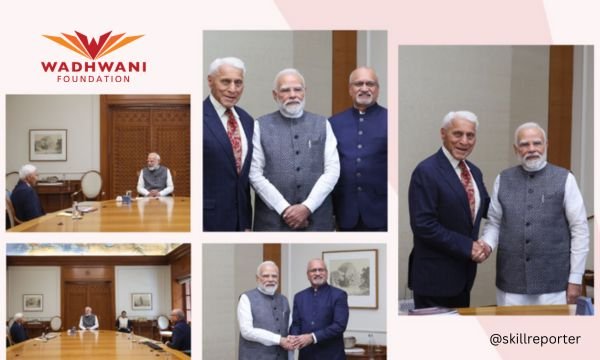
In parallel, this vision resonated at the highest levels of national leadership. During discussions with Hon’ble Prime Minister Shri Narendra Modi, Dr. Wadhwani and Dr. Ajay Kela, CEO of Wadhwani Foundation, reiterated the Foundation’s mission around skilling, entrepreneurship, and innovation as building blocks of India’s growth journey. The lens remained clear — AI is not just a technology milestone; it is a capability enabler when paired with people and learning systems.
At the Voices of Harvest Awards 2025, PepsiCo India leadership highlighted how future-ready skilling — developed through partnerships including Wadhwani Foundation’s digital learning ecosystem — is helping teams and partner networks grow with confidence and clarity.” This keeps it anchored in what’s documented.
This approach matters because India’s opportunity in AI is fundamentally people centric. Whether in corporate environments, higher education, or state-led capacity building, the question is increasingly moving from “How do we adopt AI?” to “How do we prepare people to work confidently in an AI-shaped world?”
The answer lies in three emerging patterns. First, building clarity and confidence — ensuring individuals are not just trained, but understand where AI aligns with their roles and aspirations. Second, embedding capability-building within institutions instead of leaving it to isolated initiatives. Third, treating AI as a productivity and empowerment layer rather than an abstract technological pursuit.
Across these developments, the Wadhwani Foundation’s work sits in an interesting intersection — bridging policy intent, industry practice, and human capability. By staying anchored to skilling, entrepreneurship, and applied AI enablement, it has contributed to moving the conversation beyond “future of technology” to “future of people.”
India’s AI moment, then, is not only about breakthroughs in algorithms. It is about building a workforce that can use these breakthroughs productively, responsibly, and confidently. And that story is quietly, steadily taking shape.