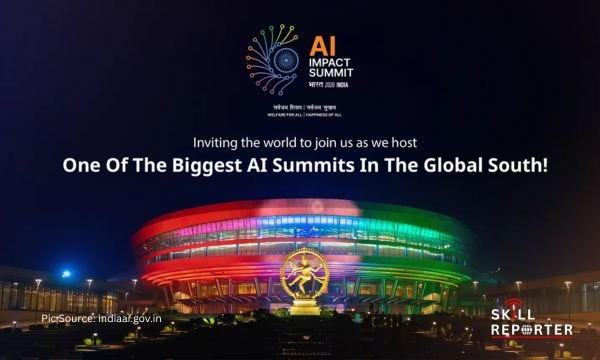
For India, AI functions as a strategic national tool to drive the democratisation of technology, ensuring access, inclusion, and equity at scale. This technological revolution has opened vast opportunities for advancements across every domain of human endeavour. India’s role in global technology and governance forums continues to expand, reflecting its growing engagement in shaping international policy discourse on emerging technologies. As part of this growing global engagement, the India AI Impact Summit 2026 is slated to take place in New Delhi from 16–20 February. It will be the first-ever global AI summit to be hosted in the Global South.
The Summit will serve as an impact-focused global platform, shaping AI into measurable outcomes across economies, aligning with the national vision of Welfare for All, Happiness of All and global principle of AI for Humanity. It will bring together global leaders, policymakers, innovators, and experts to showcase applications and define AI pathways across governance, innovation, and sustainable development.
The India–AI Impact Summit 2026 will be the first global AI summit to be hosted in the Global South.
Core Principles: The Three Sutras Articulating the AI Impact
The India–AI Impact Summit 2026 is guided by three foundational pillars, referred to as Sutras, which articulate the core principles guiding global cooperation on AI.
- People: Promoting human-centric AI that safeguards rights, enhances access to services, builds trust, and ensures equitable benefits across societies.
- Planet: Advancing environmentally sustainable AI by encouraging energy-efficient systems, responsible resource use, and applications that support climate action and environmental resilience.
- Progress: Enabling inclusive economic and technological advancement through innovation, capacity building, and the use of AI to drive productivity, growth, and development outcomes.
The India-AI Impact Summit 2026 has attracted significant high-level engagement, with 15–20 Heads of Government, over 50 international ministers, and more than 40 global and Indian CEOs expected to participate.
Over 100 countries are engaging through the Seven Chakra or Working Groups, reflecting broad global participation in shaping responsible and inclusive AI.
The Summit’s deliberations are organised through Chakras or Working Groups structured around seven interconnected thematic areas. Each Chakra focuses on a core area of AI impact and translates the Sutras into concrete areas of action across policy and real-world applications. Over 100 countries worldwide have engaged through these Working Groups to shape a future of responsible and inclusive AI.
Each Chakra fosters multilateral collaboration on AI’s societal impacts, from building skills to ensuring ethical deployment.
India’s rapid adoption of AI is opening new pathways for innovation and inclusive growth across sectors. As technology evolves, India is advancing workforce readiness for an AI-driven economy while ensuring broad participation across regions and socio-economic groups. The Human Capital thematic working group focuses on strengthening these efforts by shaping an equitable AI skilling ecosystem that enables smooth workforce transitions and equips citizens with capabilities for emerging roles.
The Summit is also anchored in three Sutras: People, Planet and Progress which define the core principles for global cooperation on AI.
Key National Indicators of India’s Talent-Force
- AI Skills and Talent Growth: India ranks among the top countries globally in AI skillpenetration and has grown more than threefold since 2016 in terms of AI talent concentration.
- Global Leadership in AI Capability: As per the Stanford AI Index Report 2025, India leads global AI talent acquisition with about 33% annual hiring growth and ranks among the top three in the Global AI Vibrancy Tool.
- Empowering AI Workforce: Under the IndiaAI FutureSkills, the government is supporting 500 PhD scholars, 5,000 postgraduates, and 8,000 undergraduates in AI research and training.
- Global Outreach: IndiaAI Mission under MeitY selected 10 Indian AI startups for the IndiaAI Startups Global Initiative, a global acceleration programme with Station F, Paris, the world’s largest startup campus, and HEC Paris, a top-ranked European business school, positioning India’s AI innovation on the world stage.
- Employment Impact: AI is set to transform India’s tech services sector by redefining the workforce, with the potential to create millions of jobs over the next few years.
Also Read: Skilling for AI Readiness (SOAR) Initiative Launched to Make School Children AI Ready
Government-led investments in skilling, research, and global exposure are strengthening domestic capabilities while aligning them with international requirements. These efforts position India as a dependable and inclusive partner in advancing global cooperation on AI.
Sessions on 16 February 2026
| Topic | Details |
|---|---|
| Leadership Talk: Harnessing AI for the Future of Learning and Work |  16 Feb 2026 16 Feb 2026 9:30 AM – 10:30 AM 9:30 AM – 10:30 AM Bharat Mandapam Bharat Mandapam L1 Meeting Room No. 18 L1 Meeting Room No. 18Speakers: – Dr. Matteo Zallio, University of Cambridge – Mustafa Furniturewala, Coursera – Rajiv Tandon, BITS Pilani – Digital – Sanjay Jain, Google – Tapish Bhatt, Coursera Description: This leadership talk explores how AI is reshaping global employment and redefining future skills. It highlights the need for continuous, skills-based learning to build resilient, future-ready talent, and examines how education systems, workforce strategies, and policy frameworks must align. Through real-world examples, it showcases practical, collaborative approaches to accelerating AI readiness and closing critical skills gaps. Knowledge Partners: Coursera India Pvt Ltd |
| The Future of Employability in the Age of AI | 16 Feb 2026 9:30 AM – 10:30 AM Bharat Mandapam West Wing Room 4 A Speakers – Dr. V Anantha Nageswaran, GoI – Mr. Alok Agrawal, AI4India – Mr. Sanjeev Bhikchandani, InfoEdge – Mr. Sateesh Seetharamiah, EdgeVerve – Mr. Vineet Nayar, Sampark Foundation – Ms. Smita Prakash, ANI – Prof. Anurag Mairal, Stanford University of Medicine – Shashi Shekhar Vempati, AI4India Description: AI will create more job opportunities but also make many existing jobs redundant. This will also require skilling and re-skilling of workers across the spectrum. The Panel Discussion will focus on short-term and long-term impact of AI on employment, both at the industry level (e.g., manufacturing, healthcare, automobile) and function level (e.g., HR, sales, supply chain). Moreover, the panel will identify steps to be taken to mitigate the risks by enhancing opportunities. Knowledge Partners: DeepTech4Bharat Foundation |
| AI and the Future of Skilling: Strengthening Human Capital and Transforming Higher Education Institutions | 16 Feb 2026 9:30 AM – 10:30 AM Bharat Mandapam L1 Meeting Room No. 9 Speakers – Ashish Kulkarni, Indian Institute of Creative Technologies and National Chairman – AVGC-XR Forum – Dr. Manish Kumar, NSDC, Championing AI First Solution for Skilling – Narayanan Ramaswamy, KPMG – Professor MS Vijay Kumar, MIT’s Education Innovation Movement – Shankar Maruwada, EkStep Foundation Description: As AI transforms economies, developing strong human capital is increasingly important for workforce readiness. This session on “AI and the Future of Skilling” at the India AI Impact Summit 2026 will convene stakeholders from government, industry, and academia to discuss approaches to building an AI-ready workforce. The discussion will explore policy pathways, industry–academia collaboration, institutional AI readiness, future-focused skilling frameworks, and capacity-building across higher education to support employability, innovation, and broader adoption. Knowledge Partners: KPMG |
| Empowering the Human Edge: Building a Future-Ready Workforce in the Age of AI | 16 Feb 2026 10:30 AM – 11:30 AM Bharat Mandapam L1 Meeting Room No. 18 Speakers – Aparna Ganesh, Tata Sons – Idris A. Rai, Inter University Council for East Africa – Jay Krishnan, Beyond Next Ventures – Phani Nagarjuna, Telangana AI Innovation Hub – Roma Datta Chobey, Google India – Sidharth Madaan, BCG – Vani Kola, Kalaari Capital Description: Bringing together governments, enterprises, and academic leaders, this session will spotlight how large-scale AI skilling and reskilling initiatives are being designed and delivered; the gaps emerging in AI talent supply; and what it takes to build a workforce that can adapt and thrive in an AI-driven economy. The discussion will surface practical lessons and scalable approaches for building inclusive, future-ready AI talent ecosystems. Knowledge Partners: Japan International Cooperation Agency |
| AI and the Future of Work: Employability, Skills, and Labour Market Transformation | 16 Feb 2026 1:30 PM – 2:30 PM Bharat Mandapam L1 Meeting Room No. 14 Speakers – Dr Dhanya M. B., V. V. Giri National Labour Institute – Shri Ajoy Sharma, Ministry of Labour & Employment, GoI – Shri Kartik Narayan, Apna – Shri Ritesh Hada, Karnavati University Description: This panel examines how Artificial Intelligence is reshaping labour markets, from job creation and skill transitions to education and policy responses. Bringing together government, research, industry, and academia, the discussion explores AI-enabled employment platforms, emerging skill demands, workforce strategies, and how education systems can evolve to prepare workers for an AI-driven economy. Knowledge Partners: Apna.co |
| The Future of Work for the Global South: Skilling for Opportunity and Social Mobility | 16 Feb 2026 3:30 PM – 4:30 PMBharat Mandapam L1 Meeting Room No. 18 Speakers – Abhineet Kaul, Access Partnerships – Abhishek Singh, IndiaAI Mission and Ministry of Electronics and Information Technology (MeitY) – Angelica Salvi Del Pero, OECD (France) – Anjali Kaur, Chair on India and Emerging Asia Economics, Center for Strategic and International Studies – Chenie Yoon, Google – Naina Subberwal Batra, AVPN Description: This high-level panel explores how AI-driven workforce transformation can unlock economic opportunities and social mobility across the Global South. Convening policymakers, industry leaders, and practitioners, the session examines critical skills gaps, regional priorities, and actionable frameworks for inclusive AI upskilling. Drawing on India’s policy leadership and cross-country insights, participants will engage in dialogue to shape future-proof roadmaps that ensure equitable access to AI skills, empowering vulnerable populations and strengthening workforce readiness across emerging economies. Knowledge Partners AVPN |
| Women at the Frontline of AI: Reimagining Skilling for India’s Community Health Workforce | 17 Feb 2026 1:30 PM – 2:30 PM Bharat Mandapam West Wing Room 4 A Speakers – Amrita Mahale, ARMMAN – Ashish Srivastava, AI Innovation for Inclusion Initiative, IIIT Bangalore – Hamid Adbullah, Khushi Baby Description: This session examines how AI can strengthen India’s women-led community health workforce through inclusive skilling and real-world deployment. Drawing on large-scale use of LLM-powered tools with ASHAs and ANMs across multiple states, the session explores productivity gains, quality of care, and equitable AI access in rural settings. The discussion highlights practical pathways for building a scalable, gender-responsive, AI-enabled frontline workforce in India and globally. Knowledge Partners Khushi Baby |
| AI in Work: Humans, AI, or Both? | 17 Feb 2026 1:45 PM – 2:45 PM Bharat Mandapam L2 Audi 2 Speakers – David Yanagizawa-Drott, University of Zurich – Elizabeth Kelly, Anthropic – Murugan Vasudevan, Veddis – Shankar Maruwada, EkStep Foundation Description: How can AI help in enhancing recruitment pipelines to improve efficiency and productivity of firms? This session, featuring a presentation by an international researcher on a randomised evaluation on leveraging AI tools to improve teacher hiring, followed by a panel discussion with leading practitioners. This discussion will examine how AI can reshape recruitment pipelines, skill matching and workforce productivity. Participants will explore how evidence can inform the design and adoption of AI tools that enhance skills, productivity, and worker wellbeing. Knowledge Partners J-PAL |
| Reskilling for Tomorrow: AI, Sustainability, and India’s Jobs Transition | 17 Feb 2026 3:30 PM – 4:30 PM Bharat Mandapam L1 Meeting Room No. 18 Speakers – Dr Arunabha Ghosh, Council on Energy, Environment and Water (CEEW) – Dr Claire Melamed, UN Foundation – Mr Nirmit Parikh, Apna Jobs and Bluemachines AI – Ms Aditi Jha, LinkedIn India – Ms Sabina Dewan, JustJobs Network Description: India’s move toward a green and digital economy is reshaping jobs, skills, and employer expectations. This panel examines how AI and automation can support skill mapping, personalised training, and workforce transitions—while addressing challenges of access, trust, and inequality. Policymakers, industry, training providers, and technology experts will discuss how India can prepare workers for emerging green and tech-enabled roles and build inclusive, future-ready skilling systems. Knowledge Partners Council on Energy Environment and Water (CEEW) |
| India Future Skills and AI Collaborative Roundtable: Building Workforces, Capacities, and Institutional Readiness | 17 Feb 2026 5:30 PM – 6:30 PM Bharat Mandapam L1 Meeting Room No. 18 Speakers – Antara Lahiri, Micron Foundation – Bhomik Shah, CSRBOX – Hemant Lohiya, Redington Foundation – Kumar Anurag Pratap, Capgemini – Parminder Singh Kakria, Kyndryl – Pratima Harite, Lenovo – Shipra Sharma, IBM Description: This strategic session advances the IndiaAI Mission’s vision of AI for People, Planet, and Prosperity through inclusive, human-centered implementation. Built on two years of engagement, pilots, and practitioner insights, it converts intent into impact via commitments, scalable models, and partnerships. The discussion will focus on AI workforce readiness, large-scale faculty capacity building, and institutional readiness to integrate AI systems, infrastructure, and governance. Knowledge Partners CSRBOX |
| Cracking the AI Skill Code: Capabilities, Mindset, and Workplace Readiness (Hosted by BITS Pilani) | 18 Feb 2026 10:00 AM – 11:30 AM Bharat Mandapam – Expo Area Hall No. 4 First Floor – Session Hall 3 Description: Artificial Intelligence is rapidly becoming a core workplace utility across functions, requiring professionals to move beyond basic awareness toward practical capability. The key challenge is understanding what to learn, which tools truly matter, and how to adapt thinking and work styles for an AI-enabled environment. This session outlines an “AI Skill Code,” offering practical guidance, interdisciplinary insights, and real-world examples, while showcasing how BITS Pilani WILP is redesigning AI education through foundations-driven, practice-oriented programs. Knowledge Partners BITS Pilani |