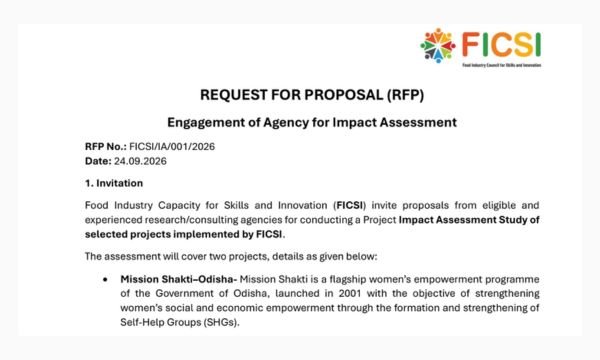
Food Industry Capacity for Skills and Innovation (FICSI) invite RFP proposals from eligible and experienced research/consulting agencies for conducting a Project Impact Assessment Study of selected projects implemented by FICSI. (RFP No.: FICSI/IA/001/2026)
The assessment will cover two projects, details as given below:
- Mission Shakti–Odisha – Mission Shakti is a flagship women’s empowerment programme of the Government of Odisha, launched in 2001 with the objective of strengthening women’s social and economic empowerment through the formation and strengthening of Self-Help Groups (SHGs). The programme supports women by promoting skill development, financial inclusion, livelihood generation, access to credit, entrepreneurship, and market linkages. The proposed impact assessment will examine the programme’s contribution to improving women’s income and livelihoods, employment opportunities, financial independence, participation in household and community-level decision-making, and overall socio-economic empowerment.
The project is being implemented through an FICSI-affiliated training partner, using NCVET-approved job roles and TOT-certified trainers. Training and related interventions are being undertaken across the identified clusters of Cuttack, Kandhamal, Balasore, Dhenkanal, and Barabati in Odisha. - Pre-Apprenticeship Skill Enhancement Program (P-ASEP) – is an initiative supported by PepsiCo India in collaboration with FICSI, aimed at enhancing the employability of youth and developing an industry-ready workforce for the food-processing sector. The programme integrates classroom-based skill training with practical workplace exposure and provides participants with pathways to apprenticeship opportunities under the National Apprenticeship Promotion Scheme (NAPS).
The programme focuses on equipping participants with industry-relevant technical, Food Safety & Hyigne and employability skills, recognized certification, and hands-on practical experience to facilitate their transition from training to employment and apprenticeship.
While the programme places particular emphasis on increasing participation and employment opportunities for women, it also provides opportunities for male participants. P-ASEP is being implemented across multiple states in India, with the current implementation covering seven states: Madhya Pradesh, Uttar Pradesh, Assam, Tamil Nadu, Karnataka, Delhi, and West Bengal. The programme is designed to address the evolving skill requirements of the food-processing industry while creating sustainable pathways for youth into employment and apprenticeship. The project is being implemented through Food Processing Organizations and Third Party Aggregator (TPA), using NCVET-approved job roles and TOT-certified trainers. Training and related interventions are being delivered across the identified locations in the seven states, with a focus on strengthening participants’ technical competencies, workplace readiness, practical exposure, and transition to apprenticeship and employment opportunities.
Objective
The key objective is to assess the:
- EƯectiveness and relevance of the projects.
- Reach and coverage of beneficiaries.
- Outcomes and impact of interventions.
- Changes in livelihood, employment, income and skills, wherever applicable.
- Beneficiary satisfaction.
- Implementation challenges and gaps.
- Sustainability of project outcomes.
- Good practices and success stories.
Scope of Work
The selected agency shall:
- Review project documents and available MIS/data.
- Develop an appropriate impact assessment methodology.
- Conduct primary data collection from beneficiaries and stakeholders.
- Conduct surveys, interviews/FGDs, as required.
- Analyse project outputs, outcomes and impact.
- Prepare case studies/success stories.
- Identify gaps and implementation challenges.
- Provide actionable recommendations for future projects.
Key Deliverables
The agency shall submit:
- Inception Report and methodology
- Sampling plan and data collection tools
- Fieldwork report
- Cleaned dataset and analysis
- Draft Impact Assessment Report
- Final Impact Assessment Report
- Executive Summary and presentation
Duration
The assignment shall be completed within 8 weeks from the date of award of the assignment.
Eligibility
The agency should have:
- Minimum 5 years of relevant experience.
- Experience in impact assessment/evaluation studies.
- Experience in primary research and field surveys.
- Experience in skill development, livelihoods, women empowerment, CSR or related projects will be preferred.
- A qualified team with expertise in research, statistics/data analysis and social development.
Proposal Requirements
The proposal should contain:
- Technical Proposal
- Organisation profile
- Relevant experience
- Understanding of the assignment
- Proposed methodology
- Work plan
- Team composition and CVs
- Sample Report
- Financial Proposal
- Professional fees
- Fieldwork/survey costs
- Travel and other expenses
- Applicable taxes
- Total project cost
Evaluation
Proposals will be evaluated based on:
- Relevant experience
- Understanding of the assignment
- Methodology
- Team qualifications
- Work plan
- Financial proposal
FICSI may follow Quality and Cost Based Selection (QCBS) for selection of the agency.
Submission
Interested agencies may submit their proposals to:
Food Industry Capacity for Skill and Innovation (FICSI)
Shriram Bhartiya Kala Kendra Building
3 Floor, Copernicus Marg,
New Delhi, Delhi 110001
or
Email: santosh@ficsi.in
Last Date for submission:
06 October 2026
Subscribe on LinkedIn