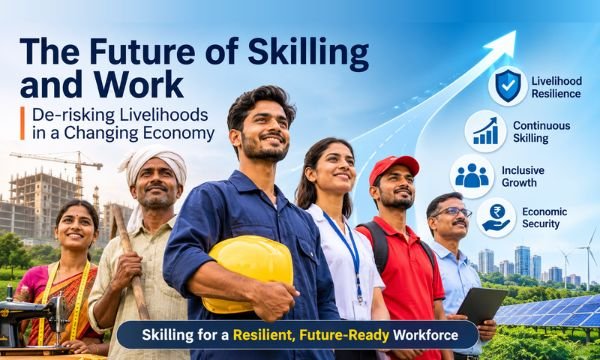
Why India’s skilling ecosystem must move beyond employability to strengthen income security, occupational adaptability and sustainable livelihoods.
India’s skilling challenge is no longer limited to preparing people for jobs. It is increasingly about ensuring that individuals can sustain their livelihoods as technology, market dynamics, climate change and evolving employment models reshape the world of work.
The scale of this challenge is evident in India’s employment landscape. According to NITI Aayog’s 2025 report, approximately 550 million of India’s 634 million employed workers (87%) were informally employed in 2023–24. Meanwhile, India’s gig workforce expanded by 55% between FY21 and FY25, reaching 12 million workers. Globally, the World Economic Forum (WEF) estimates that 39% of workers’ existing core skills could change by 2030.
These developments raise a question that deserves greater attention in India’s skill development discourse: Are we preparing people only to enter the workforce, or are we equipping them to navigate uncertainty, adapt to changing occupations and sustain their ability to earn?
The next phase of skilling must address both.
The changing landscape: Why livelihood resilience matters
India’s workforce comprises agricultural workers, artisans, small entrepreneurs, self-employed individuals, salaried employees, construction workers and gig workers. Their economic circumstances differ, but many face common vulnerabilities: unstable earnings, limited social protection, changing skill requirements and inadequate access to new markets.
Consider the following indicators.
India’s livelihood and workforce landscape
| Indicator | Latest reported figure |
|---|---|
| Informally employed workforce in India (2023–24) | 550 million (87%) |
| Gig workforce (FY25) | 12 million |
| Gig workers reporting monthly earnings below ₹15,000 | Around 40% |
| Existing worker skills expected to change globally by 2030 | 39% |
| Indian youth (15–29) with formal vocational training (2025) | 5% |
| Indian youth with formal or other-than-formal vocational training (2025) | 30.7% |
Sources: NITI Aayog, Economic Survey 2025–26, PLFS 2025 and WEF Future of Jobs Report 2025. The figures relate to different populations and reference periods.
The implications are significant.
For informal workers, livelihood risks often arise from irregular income, limited financial protection and low productivity. For gig workers, flexibility can come with income volatility and dependence on digital platforms. For traditional artisans, changing consumer preferences and limited market access can threaten the viability of existing occupations. For industrial workers, technological advancements can make continuous learning essential.
The challenge is therefore not simply to create new employment opportunities, but to ensure that people can adapt to economic change without losing their capacity to earn.
Nine priorities for de-risking livelihoods through skilling
A livelihood-resilient skilling ecosystem must address the risks faced by workers across different occupations. Nine priorities deserve particular attention.
| Priority | What needs to change |
|---|---|
| 1. Strengthen existing livelihoods | Upgrade occupational skills, improve productivity and introduce digital and financial competencies for informal and self-employed workers. |
| 2. Protect gig and platform workers | Combine digital, logistics and customer-service skills with financial literacy, social security and portable benefits. |
| 3. Anticipate technological disruption | Promote continuous reskilling, AI awareness, digital literacy and technology-enabled occupational transitions. |
| 4. Modernise traditional occupations | Combine traditional competencies with contemporary design, quality standards, digital marketing and e-commerce. |
| 5. Build climate-resilient livelihoods | Develop green skills, climate-resilient agricultural practices, renewable energy competencies and sustainable resource management. |
| 6. Enable income diversification | Encourage multi-skilling, entrepreneurship and complementary occupations to reduce dependence on a single income source. |
| 7. Recognise existing competencies | Strengthen Recognition of Prior Learning (RPL), competency-based assessment and portable qualifications. |
| 8. Integrate skilling with financial protection | Connect training with credit, insurance, pensions, occupational safety and social security. |
| 9. Align training with real economic opportunities | Use local livelihood mapping, labour-market intelligence and industry partnerships to improve training relevance and outcomes. |
These priorities require a shift in how skilling is designed and delivered. For example, an agricultural worker may benefit from additional competencies in food processing, farm machinery maintenance or direct marketing. An artisan may need digital commerce and product development skills, while a gig worker could progress towards logistics coordination or fleet management.
The objective should not always be to move individuals into entirely different occupations. In many cases, improving the productivity, market access and earning potential of their existing livelihood may deliver greater economic value.
India’s policy response: Building blocks already exist
India has several initiatives that provide a foundation for this broader approach. Their significance lies not only in the number of people they reach, but also in how they connect skills with occupational progression, enterprise development and worker protection.
1. PM Vishwakarma: Strengthening traditional livelihoods
The PM Vishwakarma scheme integrates skill upgradation, tool-kit support, financial assistance and market linkages for artisans and craftspeople across 18 traditional trades.
According to the Economic Survey 2025–26, as of 1 December 2025, 30 lakh beneficiaries had registered under the scheme, of whom 23.09 lakh had been trained. The scheme also provides access to collateral-free loans of up to ₹3 lakh at concessional interest rates and digital transaction incentives.
This illustrates how skilling can be combined with productive assets, finance and market access to strengthen existing occupations.
2. PM-SETU: Modernising vocational training for changing industry needs
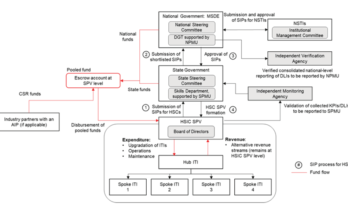
The Pradhan Mantri Skilling and Employability Transformation through Upgraded ITIs (PM-SETU) scheme represents an important step towards industry-linked vocational education.
With an estimated outlay of ₹60,000 crore, the scheme aims to upgrade 1,000 government ITIs through a hub-and-spoke model involving 200 hub ITIs and 800 spoke ITIs. Industry partners are expected to participate in cluster management, training design and employment-oriented outcomes.
Its relevance extends beyond infrastructure modernisation. The scheme can help align traditional trades with new technologies and changing occupational requirements.
3. e-Shram: Connecting informal workers with welfare and opportunities
The e-Shram portal provides a national database of unorganised workers and facilitates access to welfare, employment and skilling-related services.
The Economic Survey 2025–26 reported more than 31 crore registered unorganised workers on the portal as of January 2026, with women accounting for 54% of registrations.
The opportunity is to strengthen the connection between worker identification, skill assessment, training opportunities, employment services and social protection.
Together, these initiatives demonstrate that India has important institutional building blocks. The next challenge is to improve their convergence and measure their impact on the economic sustainability of livelihoods.
Beyond training numbers: What should the skilling ecosystem measure?
A major limitation of conventional skilling approaches is their reliance on output indicators such as enrolments, training completions, certifications and placements. These remain important, but they do not necessarily establish whether a person’s economic circumstances have improved.
For a livelihood-oriented approach, success should increasingly be assessed through measurable outcomes.
| Conventional indicators | Livelihood-resilience indicators |
|---|---|
| Number of people trained | Improvement in occupational productivity |
| Certificates awarded | Recognition and utilisation of competencies |
| Placement numbers | Employment retention and income progression |
| Training completion | Application of skills in actual work |
| Entrepreneurship registrations | Business survival, growth and market access |
| Training participation | Access to continuous learning and occupational mobility |
This calls for stronger institutional collaboration.
Policymakers and State Skill Development Missions can incorporate local livelihood mapping into training plans. Sector Skill Councils and NCVET can support relevant occupational standards and recognised qualifications. Training institutions can offer flexible, modular learning opportunities, while industry can contribute through apprenticeships, workplace training and technology exposure.
Financial institutions and social protection agencies must also be part of this ecosystem, particularly for workers whose livelihoods depend on self-employment and informal economic activity.
The way forward: From employability to livelihood resilience
The future of skilling cannot be defined exclusively by the jobs that emerging technologies create or the occupations that automation transforms. It must also account for the millions of people whose existing livelihoods need to evolve.
For India, this means moving beyond a one-time training approach towards continuous learning, occupational adaptability and stronger connections between skills, markets and financial protection.
The shift can be understood through two complementary approaches:
Conventional skilling: Training → Assessment → Certification → Employment
Livelihood-oriented skilling: Skills → Productivity → Income improvement → Diversification → Resilience
The second approach does not replace the first. It expands its scope to recognise the needs of workers who are already economically active but require better opportunities, recognised competencies and protection against disruptions.
Ultimately, the success of India’s skilling ecosystem should not be measured only by how many people it trains, certifies or places. It should also be measured by whether individuals can improve their earnings, sustain their occupations, diversify their opportunities and adapt to changing economic conditions.
The real test of future-ready skilling is not merely whether people can find work today, but whether they can continue to earn, adapt and progress tomorrow.
Sources and References:
- NITI Aayog (2025) – India’s Services Sector: Insights from Employment Trends and State Level Dynamics. Informal employment estimates and sectoral workforce distribution.
- Ministry of Finance, Government of India (2026) – Economic Survey 2025–26: Chapter 12 – Employment and Skill Development. Gig workforce, income vulnerabilities, PM Vishwakarma, PM-SETU, RPL and employment trends.
- Ministry of Finance / PIB (29 January 2026) – Economic Survey 2025–26: Employment and skilling initiatives. e-Shram registrations and employment developments.
- World Economic Forum (2025) – Future of Jobs Report 2025: Skills Outlook. Global skills disruption projections.
- Ministry of Statistics and Programme Implementation (2026) – Periodic Labour Force Survey Annual Report 2025. Formal and other-than-formal vocational training statistics.
- Ministry of Skill Development and Entrepreneurship (2026) – Year End Review 2025. PM-SETU and PM Vishwakarma implementation details.
- PM-SETU: What Is the Scheme, How Will It Transform ITIs, and What Does It Mean for India’s Skill Ecosystem?
Stay tuned the for the next article in the series “Rethinking the Future of Skilling”