The Carbon Accounting Crisis on the Shop Floor
The global manufacturing sector is facing an unprecedented transformation. For decades, the primary metrics of industrial success were simple: throughput, machine uptime, and cost per unit. Today, a new, uncompromising metric has entered the boardroom: embedded carbon efficiency. With global regulations like the European Union’s Carbon Border Adjustment Mechanism (CBAM) penalising high-emission imports, and domestic net-zero targets tightening, sustainability is no longer a corporate social responsibility (CSR) checkbox. It is a core requirement for market access
As a consulting professional navigating the intersections of heavy manufacturing, construction, and MEP (Mechanical, Electrical, Plumbing) networks, I see a massive structural challenge. India’s capital goods sector—the machinery, boilers, yellow goods, and industrial plants that power our economy—is inherently asset-heavy and historically carbon-intensive. We cannot simply scrap trillions of rupees worth of legacy industrial infrastructure to meet 2030 and 2050 climate goals. The economic cost would be catastrophic. Instead, the path to survival lies in a massive, coordinated effort to retrofit existing capital goods for a net-zero, circular economy. However, this transition faces a major obstacle: a severe shortage of green-collar industrial talent.
Redefining Capital Goods: From Linear to Circular Systems
The traditional lifecycle of industrial equipment follows a linear path: take, make, use, and dispose. A heavy hydraulic excavator, a massive factory boiler, or a commercial plumbing chiller is run until it breaks down, undergoes patchwork repairs, and is eventually sold as scrap metal. The green collar revolution completely flips this model, shifting the industry toward a circular lifecycle framework.
This structural shift introduces three highly technical, sustainable engineering processes to the shop floor: Industrial Retrofitting: Upgrading legacy machinery with variable speed drives, high-efficiency premium motors (IE3/IE4 standards), and smart IoT sensors to track energy consumption in real time and slash operational emissions. True Remanufacturing: Disassembling worn-out capital goods to the component level, inspecting them, reworking them to original technical specifications, and reassembling them with an “as-new” warranty. This process uses up to 80% less energy than manufacturing a new machine from scratch. Closed-Loop Fluid & Material Systems: Designing industrial plumbing, HVAC, and hydraulic networks to endlessly recycle water, oils, and process chemicals, completely eliminating industrial waste runoff.
The New Skill Set: The Rise of the Green-Collar Engineer
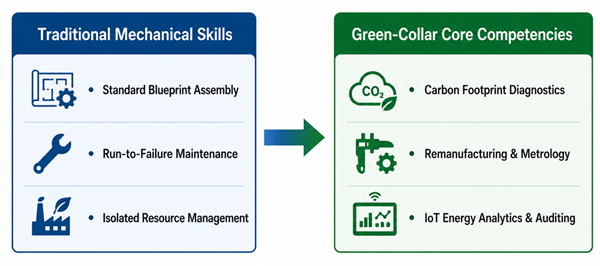
To make this circular model work, we need an entirely new kind of industrial worker: the green-collar technician. The skills needed to build a brand-new machine from a fresh blueprint are very different from the skills needed to safely cut open, diagnose, re-engineer, and modernise an operational, thirty-year-old blast furnace or automated assembly line.
The future workforce must be highly skilled in three core areas:
- Carbon Footprint Diagnostics & Auditing: Technicians must look at a plant’s layout—including its steam pipelines, compressed air systems, and electrical grids—and identify energy leaks, thermal waste, and friction losses using advanced thermal imaging and ultrasonic tools.
- Advanced Metrology and Non-Destructive Testing (NDT): In a remanufacturing plant, workers must use advanced NDT methods (like ultrasonic testing and magnetic particle inspection) to find microscopic stress cracks in heavy cast components, determining exactly which parts can be safely remanufactured and which must be recycled.
- Cross-Disciplinary Automation and Fluid Management: Modern green plumbing and MEP systems use complex, low-emission refrigerants, water reclamation technologies, and variable-flow smart valves. Technicians must combine classic pipe-fitting skills with digital automation troubleshooting to manage these eco-friendly systems.
Decentralised Skilling for the MSME Supply Chain
While tier-one industrial conglomerates have the financial reserves to invest in green training programs, the broader capital goods ecosystem relies on thousands of Micro, Small, and Medium Enterprises (MSMEs). These smaller machine shops, forging units, and casting clusters are the companies that actually supply the components for heavy machinery. If our MSMEs cannot verify the carbon footprint of their parts, they will be cut out of global supply chains. Yet, a small foundry operator in Coimbatore or a tool-room owner in Ludhiana cannot afford to send their best operators away for expensive, months-long sustainability certifications. The Capital Goods & Strategic Skill Council (CGSSC) can bridge this gap by introducing hyper-focused, accessible Green Micro-Credentials
I believe…
The shift to green manufacturing cannot simply be a response to government penalties. It must be driven by an active, strategic partnership between industry leaders, educational institutions, and skill councils.
To secure a leading position in the global green economy, industrial leaders may require to focus on three immediate initiatives:
Launch Shared Remanufacturing Academies: Major equipment manufacturers should (in partnership with CGSSC) build regional centres focused on the arts of disassembling, re-engineering, and certifying legacy machinery.
Design Circular Apprenticeship Programs: Update standard technical apprenticeship paths to include mandatory rotations focused on energy auditing, preventative digital maintenance, and materials circularity.
Update National Qualification Packs: Work closely with regulatory bodies to embed green manufacturing competencies directly into existing national skills frameworks, ensuring that sustainability is taught as a core engineering standard rather than an optional add-on.
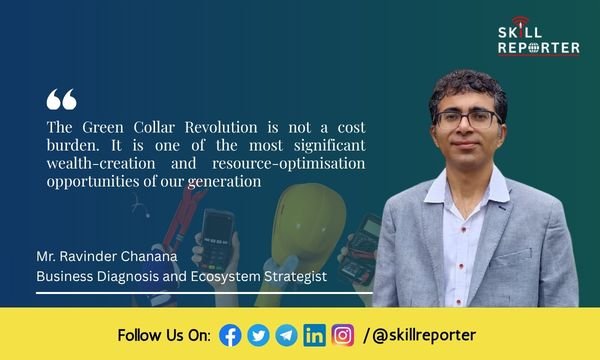
At last, the Green Collar Revolution is not a cost burden. It is one of the most significant wealth-creation and resource-optimisation opportunities of our generation. By extending the operational lifespans of our industrial machines, cutting manufacturing energy consumption, and recovering valuable raw materials, the capital goods sector can insulate itself from global resource shortages and volatile commodity prices. We have the engineering capability and the economic motivation. By systematically investing in the green-collar capabilities of our workforce, we will bridge the industrial execution gap. This focus on future-ready skills will transform our manufacturing base into a highly competitive, self-sustaining, and net-zero industrial ecosystem.
(Disclaimer: The views expressed in the article above are those of the author of the article Mr. Ravinder Chanana, Business Diagnosis and Ecosystem Strategist. The matter and intent of this article have not been edited by skillreporter.com. Skill Reporter shall not be responsible for any person/ organization directly or indirectly.)